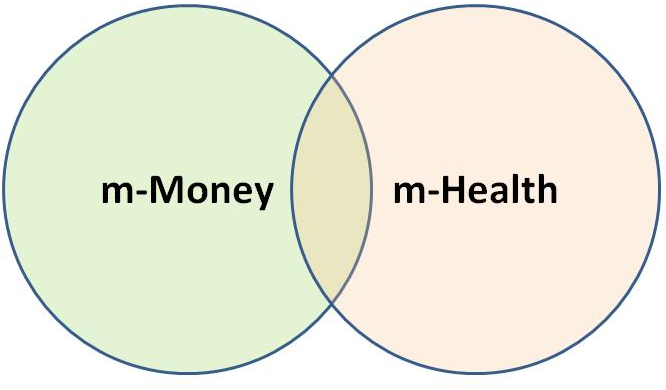
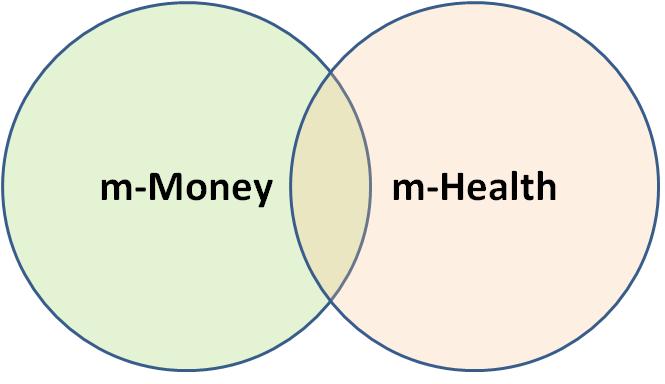
In this two-part series, MobileActive.org explores how mobile money services can support health care in developing countries. In part one, we described the key ways in which mobile money services can be adopted by the health sector.
At the primary level of care, subscription-based mobile payment services can create two-way links between patients and health care providers, as summarized here.
Patients can pay service providers directly for health care services delivered.
Service providers can use mobile transfer platforms to reward patients with monetary or airtime incentives for treatment compliance.
At the district, regional, and national levels, governments and organizations can improve management of funds and introduce better checks and balances by using mobile money platforms. Some uses include:
Mobile phones are being tried and tested in myriad ways in health care. They are used for data collection and disease surveillance, for ensuring treatment compliance, for managing health information systems and point-of-care support, for health promotion and disease prevention, and for delivering emergency medical services. Clearly, m-health, as this growing field is dubbed, is here to stay.
At the same time, achieving scale and sustainability in most m-health projects has been a challenge. One of the key aspects of beginning to think about ways to integrate m-health into health systems in a sustainable way is to establish financial systems to pay for health services and to ensure financial accountability within programs.
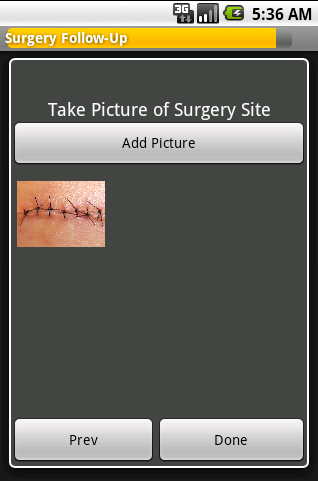
Recently, MobileActive.org spoke to the Sana Mobile team to understand how the Android-based m-health application is being used in India. The Sana application, developed at MIT's Next Lab by students and volunteers, seeks to facilitate remote consultation between specialists, often in urban centers, and community health workers working in remote low-resource settings.
Instant remote consultation for complicated cases requiring specialist input helps bring care to patients, who would otherwise have limited access to tertiary care. Sana is developed on the Android platform, enabling users to integrate voice recordings, video and high resolution images in the diagnostic process.
Read our case study that describes the mobile tool and the pilot test in Bangalore where Sana was used to screen the risk of oral cancers.
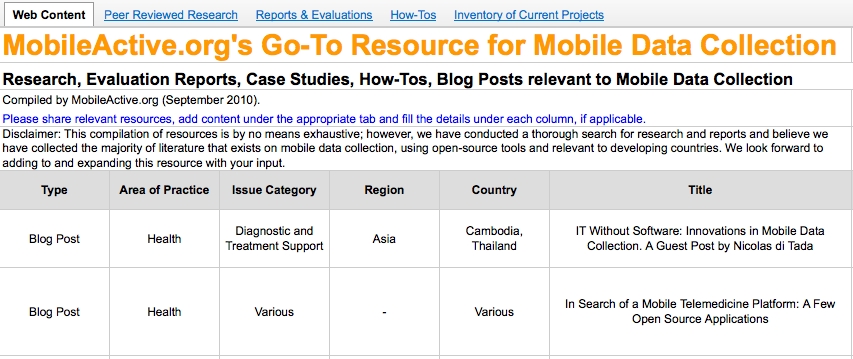
Want to use mobiles for data collection? Don't know where to start your research or where to read evaluations of existing and past mobile data collection efforts? You're in luck! We've produced the resource guide you've been waiting for.
Recently, MobileActive.org collaborated with UN Global Pulse to crowdsource an inventory of mobile data collection projects around the world. While this growing inventory shows there is enormous interest to leverage mobile technology for data collection, technical reports and evaluations of deployments and pilots are scattered.
So, we took the lead and compiled the existing literature (as best as we could) in an easy-to-use spreadsheet here.
One of the the key functions of mobile phones is their use in data collection. We have seen lots of online discussion here at MobileActive.org and elsewhere on the subject.
Here, we feature a peer-reviewed journal article from our growing list of resources on mobile data collection. In this 2009 paper, Ping et al. evaluated the effectiveness of PDA-based questionnaire verses a paper-based method for public health surveillance in Fiji.
As part of our “Mobile Research at Your Desk” series, this week we present a white paper written by Hernán Galperin in collaboration with the Diálogo Regional sobre la Sociedad de la Información (DIRSI) and International Development Research Centre (IDRC). He attempts to shed some light on the affordability of mobile phones between Latin American and Caribbean countries and compare tariffs with the rest of the world.
Recognizing that developing a single standardized metric for mobile affordability is a challenge, the author used a well-established OECD method - a basket of services - to estimate the cost of a set of mobile services specified for low-volume users.
The data exposes the reality of mobile affordability for the bottom of the pyramid.
Hernán Galperin offers a quantitative analysis using a sound approach to predict affordability of mobile tariffs. In the report, it is acknowledged that price of handsets or connection charges are not accounted for, and it is clarified that per-minute calculation can result in an over-estimation of cost.
In another report, Galperin and colleague Judith Mariscal share mobile opportunities informed by survey results of 7,000 individuals in low income households. Discussed there are perceptions of mobile service costs, and patterns of mobile usage, and both reasons for and barriers to mobile adoption. With colleague Roxana Barrantes, Galperin demonstrates the relationship between costs of mobile services and mobile penetration and discusses the savings incurred by low income users with micro-prepayment and per-second billing schemes.
All three papers can be accessed in our mDirectory for your reading.
MobileActive.org's content license is here. Please note that some materials in this slidecast may be separately copyrighted by the respective authors of the papers we presented. Images and materials are used here with the author's permission.
The Swedish International Development and Cooperation Agency (Sida) recently published a report, The Innovative Use of Mobile Applications in East Africa, that provides an overview of the current state of mobile phone applications for social and economic developments in East Africa. The report seeks to answer “what hinders the take-off of m-applications for development in East Africa" and asks what role donors should play.
While mobile phones are the main channel for information in East Africa, with mobile penetration covering over 40% of the population, sustainable, scalable mobile services for social and economic development are limited. The report is supported by secondary data, statistics, and field work carried out in Kenya, Rwanda and Tanzania, along with numerous interviews, meetings and discussions with key stakeholders in East Africa. Major trends in mobile usage, barriers for increased use of m-applications, as well as opportunities for scaling are discussed.
India is a country of villages, with over 70% of its population living in rural areas. For mobile operators, this means future mobile subscribers in the country are going to come from India’s villages.
Between 2002 and 2006, mobile penetration increased by a more than 40% in India (source ITU). Still, rural penetration is low, making up just over one fifth of the total mobile user base in India, as reported by the Telecom Regulatory Authority of India in 2007. The future of the mobile industry is exanding in rural India, but what do mobile operators need to do to tap into this market?
In 2009, Accenture, a global management consulting company, surveyed 2,400 current and potential rural consumers and interviewed 15 senior-level executives representing the mobile telephony ecosystem. The goal was to understand the needs of rural customers for mobile services and identify the value propositions for rural services by mobile operators.
At MobileActive, we’ve held a bi-weekly Research Ignite series to keep up with the latest in research related to mobiles for development. For the past few weeks, our team has been learning and discussing new research and reports. We invite you to put on your learning caps and plug into our screencasts, where we will feature some exciting developments in the world of m4d.
For this Ignite, we’re featuring three studies that were presented at the 28th ACM Conference on Human Factors in Computing Systems. The research covers mobile games in rural India and China that address literacy, and a study on mobile Internet use in South Africa.
Researchers from the Chinese Academy of Sciences, University of California, Carnegie Mellon University and Nokia Research Palo Alto developed two mobile games, Multimedia Word and Drumming Stroke, which aim to help young children in rural China recognize Chinese characters and practice strokes. It is the first known m-game that leverages a mobile learning tool for the Chinese language.
A Mobile Marakothi, a Traditional Children’s Game in India, that Teaches English
In rural India, empirical studies show that children often miss school largely due to family labor, assisting in domestic work at home or in the farm without wages or as hired labor. The authors believe that “Mobile learning can empower poor children to balance their educational and income earning goals,” and so, pursued the development of a mobile game to teach English vocabulary. Mobile phones with the m-game were deployed to children living in rural Uttar Pradesh, India for 26 weeks. The pilot identified opportunities for out-of-school learning, revealed gender influences on m-game usage and surprisingly, showed that m-games traversed caste and village boundaries and facilitated social interaction.
Presentation starts at 4:03 min.
Challenging Assumptions of Mobile Internet Access: The Experience of Women in A Township in South Africa
More and more mobile users are surfing the internet on their phones. For most people in developing countries, there is no plan B – in other words, no PC-based internet access. This study reports the experience of a group of women in Khayelitsha, in Cape Town, South Africa who connected to a mobile-based internet for the first time. In this article, six challenges facing mobile-only internet users in developing countries are identified. The authors propose how to the mobile industry can move forward by keeping the end-users in mind and introduce the concept of “digital divide” that is secondary to mobile access – it’s “after-access”.
Presentation starts at 9:59 min.
Thank you to the authors for providing permission to use images, screenshots and data as well as helpful feedback for the screencast. For more research, reports, and white papers about mobile technology for social change visit our mdirectory.