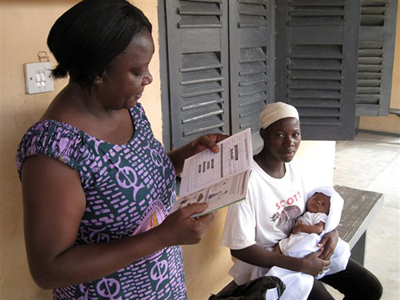
The project is two-fold. One service targets what Tim Wood, director of the Grameen Foundation’s Mobile Health Innovation and ICT Innovation divisions calls “pregnant parents,” and another targets community health workers.
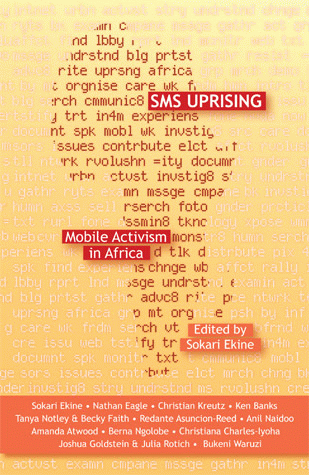
SMS Uprising: Mobile Activism in Africa is a new collection of essays and case studies examining how SMS has been used in Africa for acticism. Essays include Amanda Atwood’s report on Kubatana’s experiences in Zimbabwe setting up mobiles as a means of sharing news outside of government propaganda, to Bukeni Waruzi’s essay on collecting data on children’s rights violations in the Democratic Republic of Congo in 2004. SMS Uprising is published by Fahamu, a British-based organization with a focus on information services for Africa.
SMS Uprising provides the reader with a decent understanding of the state of mobile SMS usage in Africa today. The essays are written by writers, developers, activists, and researchers who are committed to Africa, and cover a multitude of ways SMS can be applied for advocacy work – everything from alerts about political unrest to sharing health information. The book is divided into two parts: context and case studies.
SMS Uprising is significant for many reasons not least because it has been edited by an African woman activist. Often initiatives in Africa are studied by people who are quite distant from the continent or are academics who are remote from the grassroots of the subject under discussion. The book is also unique in giving an insight into how activists and social change advocates are addressing Africa’s many challenges from within, and how they are using mobile telephone technology to facilitate these changes...The intention is that the information contained within the book will lead to greater reflection about the real potential and limitations of mobile technology.
The National Democratic Institute and MobileActive.org are hosting "New Tools for Better Elections", a conference on February 26th on new technologies for fair, representative and equitable elections. In preparation for the event, we sat down with Ian Schuler, Senior Manager of Information and Communications Technology Programs at the National Democratic Institute. Schuler specializes in the application of mobile technology for the advancement of democracy and human rights, He is the author of SMS as a Tool in Election Observation.
In this conversation, Schuler breaks down not only the differences between election observation, citizen reporting, and crowd-sourcing, but also explains why these distinctions matter and how mobile technology is changing the way elections are held. Read on for excerpts from our conversation, or scroll down to watch the interview in its entirety.
Q: You and NDI have done a lot of election monitoring around the world. Explain why election monitoring matters.
A: Elections are the main process by which people participate in their government by selecting their leaders. People expect that it’s going to be a fair process, and that it’s going to be an accurate process. So it’s important for people to have confidence to know that somebody is really systematically watching the entire process to make sure that it is good. Election monitoring prevents fraud by making it harder for the people who want to manipulate elections to do so; it detects fraud when it happens, and it lets people know if the process was good – and if it was not, what were the problems and what might be constructive, non-violent ways of remedying those problems, whether it’s simply improving the process for later or rerunning elections or whatever is warranted in that situation.
This article was written by Jesse Feiler and edited by Katrin Verclas.
In the last few week, nonprofits in the United States have started to pay attention to fundraising via text - donations delivered to charities by donors simple sending a text message.
In aftermath of the January 2010 Haiti earthquake text donations to the Red Cross and other charities received enormous publicity, and generated a significant outpouring of donations. (SMS is an alternate term for text message – a160 character message sent over the mobile network)
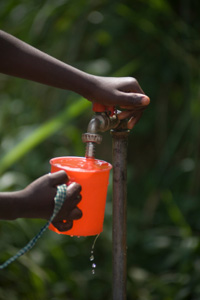
Safe drinking water is a necessity for life. But according to a 2005 report published by the World Health Organization and UNICEF, 1.1 billion people worldwide lack access to quality drinking water.
In South Africa, a current project is monitoring water quality with SMS in a push to bring safer water to the area. Run by the University of Bristol and the University of Cape Town, the four year project is two-fold: 1) develop a new means of testing water quality and 2) develop a new means of reporting the results of these water quality tests.
Aquatest, the water quality testing system, is still under development, but the Water Quality Reporter is up and running – on mobile phones with reporting via SMS. The application allows field workers to cheaply and effectively transfer data about water quality to a centralized database, while receiving feedback about how to handle local water problems.
Says Melissa Loundon, a researcher at the University of Cape Town who worked with the development of the Water Quality Reporter,
“The main part of the project is to develop the water test. But the original project team at the University of Bristol realized that if you’ve got a water test that can be used by people who aren’t in the field, or people who aren’t specialists, it doesn’t really help them if they get a result and see that their water is not safe to drink. They may not have a whole lot of resources to do anything about it. So the point of the cell phone application is that once somebody has a result, they can communicate it to a central database and also to somebody in the area who can provide support.”
In South Africa, national unemployment stands at 24% – and that number is even higher in many areas outside of major cities. Mobenzi, a new tool created by South African company Clyral, is a project to target unemployed workers to allow them to work over their mobile phones. “Mobenzi agents” use mobile phones to complete tasks that are difficult for computers to process.
Mark Fowles, co-founder of Clyral, said in an interview with MobileActive.org that the pre-pilot run of Mobenzi at the end of 2009 went better than expected. The original plan was to start a formal pilot in April 2010, but the company decided to run a pre-pilot in order to test the feasibility of the program and to iron out any problems before the main run.
The Vodafone Americas Foundation is announcing the last call for nominations for the second annual Wireless Innovation Project, a competition to identify and reward the most promising advances in wireless related technologies that can be used to solve critical problems around the globe. Proposals will be accepted through February 1, 2010, with the final winners announced on April 19, 2010 at the annual Global Philanthropy Forum in Redwood City, California.
Note: This is the first of two articles about Mobile Voices, a project based in Southern California.
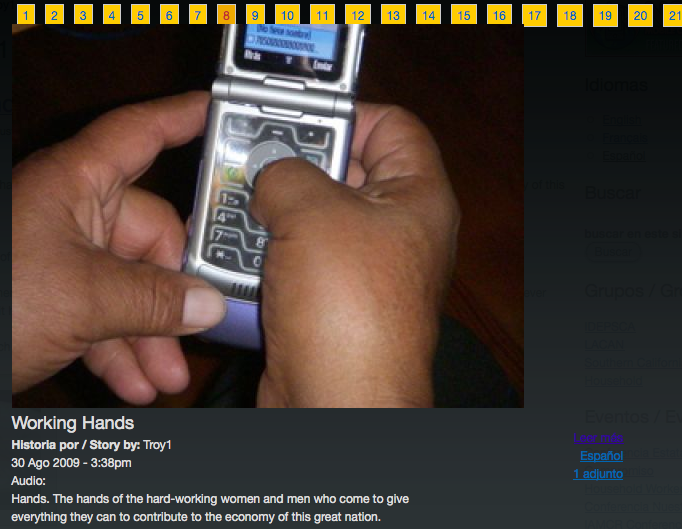
Voces Móviles / Mobile Voices is a Los Angeles-based citizen media project, a collaboration between the Annenberg School for Communication at the University of Southern California (ASC) and the Institute of Popular Education of Southern California (IDEPSCA). Mobile Voices is "a platform for immigrant workers in Los Angeles to create stories about their lives and communities directly from cell phones. Vozmob helps people with limited computer access gain greater participation in the digital public sphere."
In December 2009, US Congressman Luis Gutierrez (D – Illinois) introduced the Comprehensive Immigration Reform for America’s Security and Prosperity (CIR ASAP) Act of 2009 in the American House of Representatives. The bill is a major step in overhauling the American immigration system, providing greater protection for immigrants while ensuring that employers use fair and legal hiring practices.
As the legislative debate about this hot-button issue heats up, interest groups are increasing their advocacy to protect the rights of both documented and undocumented immigrants. With reform on so many people’s minds, two organizations have been using mobile technology to spread the word.
In the aftermath of the devastating earthquake in Haiti, relief organizations in the United States and Europe have been able to collect substantial numbers of donations from SMS fundraising campaigns. Just like after the 2004 Tsunami in Southeast Asia, the numbers are impressive. Two charities alone, the Red Cross Foundation and Yele, collected more than $4.7 million by mid-day Thursday (less than 48 hours after the first earthquake hit). UPDATE: The Red Cross has raised close to $20 million via its SMS campaign as of January 17th.
Industry insiders had expected $2 million in text message donations for all of 2009 at the end of October. However, a natural disaster of the gravity and dimension of the earthquake in Haiti has jumpstarted the awareness of aid organizations as to the potential power of raising funds quickly via SMS.
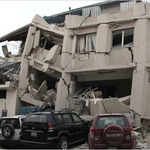
Relief efforts are ongoing after a powerful 7.0 earthquake that struck Haiti yesterday. Mobile phones play a huge part in relief efforts today, from supporting donations, citizen media coming from affected areas, to emergency relief coordination. Here are some links and information you might find useful in responding to and learning more about the Haiti earthquakes.
Mobile Donations
[This section last updated 01/15/2010 12:59 pm]
Text message donations are exploding in the aftermath of the earthquake, similar to what happened in 2004 after the Indonesian Tsunami. $9 million has already been donated by noon on Friday January 15 just to the Red Cross via the 90999 number.
A list of all short codes to text to to donate on your phone bill in the United States:
Text HAITI to 90999 to donate $10 to the Red Cross for Haiti efforts. You can donate $10 up to three times, and 100% of the donations will reach the Red Cross Foundation. This effort is run by Mobile Accord.
Text RELIEF to 30644 to get automatically connected to Catholic Relief Services and donate money with your credit card.
Text CERF to 90999 to donate $5 to The United Nations Foundation.
Text DISASTER to 90999to donate $10 to Compassion International.
Text HAITI to 85944 to donate $5 to the Rescue Union Mission and MedCorp International.
A list of all the non-US short codes that we know are serving as donation lines.
Germany: text HAITI to 81190 to donate $5 (out of which $4.83 will go to Aktion Deutschland Hilft).
Denmark: text Katastrofe to 1231 to donate 150 kr, or call 90 56 56 56.
Canada: text HAITI to 45678 to donate $5 to the Salvation Army, again courtesy of the Mobile Giving Foundation.
Italy: text to 48540 to donate to the Italian Red Cross if you are on the WIND or 3 networks. If you are on Vodacom or TIM, text 48451 to donate EUR 2 (Telecom Italia users can also call this number). (ReadMore)
France: 80 222/Croix Rouge française, 80 333/Secours Populaire, et 80 444/Secours Catholique. One euro per SMS. (From a user)
Mexico: Telcel users can text 8888, donations will go to the Carlos Slim Foundation (Thanks @sorrelkydd)
A good source for ongoing communication information is the Ushahidi Situation Room. We reported about the Ushahidi map for Haiti (Ushahidi is a mapping platform for crowdsourced crisis information) earlier, and it is being actively updated by the situation room setup at Tufts' Fletcher School. The Ushahidi blog also lists many of the other map-based information collection systems that have been set up.
This morning, Erik Hersman posted a mobile network update (01/15/2010, 10:03am) on the Situation Room page saying "Digicel is at 50% Voila & Haitel at 75%." USA Today reported yesterday that Jamaica-based Digicel has had problems getting themselves into Haiti, and that "the network is severely congested 'because of the number of people making calls and trying to receive calls.'"
A story on MSNBC from yesterday details some of TSF's work in Haiti. From the article:
Telecoms Sans Frontieres is hooking up terminals to facilitate communications for U.N. relief workers in Haiti, and will eventually let Haitians make free two-minute phone calls to anywhere in the world. The group's U.S. representative, Paul Margie, said the biggest challenge isn't technology but security. "The security and logistics situation on the ground is pretty bad, so finding secure locations to do these things is hard," he told me.
[Following was the section as it was posted the day after the earthquake, 01/13/2010, ~1:00pm]
We are hearing that Digicel, one of the main mobile operators, is intermittently working as of right now, and satellite telephone services has allowed many first-responders and witnesses to report via skype on the devastation in Haiti. Digicel has also committed $5 million for relief efforts. [WSJ]
Port-au-Prince has been severely affected including critical services such as, electricity, water and phone lines. Communication appears to be almost impossible at this time, with phone lines down. Numerous buildings, including the United Nations building, are reported to have been seriously damaged.
Facing this humanitarian catastrophe, TSF has deployed an emergency team from the American base in Managua to provide a vital support in emergency telecoms. They are carrying satellite mobile and fixed telecommunications tools. Reinforcements will also be sent from TSF’s international Headquarters. In close contact with the United Nations Office for the Coordination of Humanitarian Affairs (OCHA) and the European Commission’s Humanitarian Aid Department (ECHO), they are now flying to Saint-Domingue in order to rejoin Port-au-Prince as soon as possible.
At this stage there is very limited access because of debris and other obstacles on the roads. It seems that no communication can be made with the airport either, which is reported to be closed.
The Crisis Commons wiki is documenting some of the News, Data, and Communications efforts. In particular, they report about two mobile communication service efforts (they seek confirmation whether these are working yet):
Ushahidi - SMS:+44 7624802524 or email haiti@ushahidi.com
Twitter lists have become a quick-fire way to organize and aggregate information related to events and topics. Quite a few twitter lists have been set up by several news organizations after the Haiti earthquake. Here is a sample:
Barack Obama in speech to Americans this morning listed several ways in which the US government is trying to help relief efforts in Haiti:
Americans seeking info on family in Haiti should call 1-800-407-4747
Updates from the White House's efforts will be put on The White House Blog. From the Department of State, updates are coming on the official twitter-verified DipNote.
DipNote also says: Americans in Haiti can call the Embassy’s Consular Task Force at 509-2229-8942, 509-2229-8089, 509-2229-8322, or 509-2229-8672.
Live Blogs / Other semi-live coverage
Many blogs are covering the happenings live, and incorporating photos and videos coming in from citizen reporters in Haiti:
Reuters has a page offering live coverage of events. Includes picture reports coming in through twitter, as well as News from other sources.
CNN iReport, a citizen journalism effort, is aggregating citizen-submitted videos and photos on this page.
The Lede Blog at the New York Times has ongoing coverage.
NPR also has ongoing coverage on its Two Way blog.
We have also compiled some references for those interested in reading more about previous relief efforts and resources that might help organizations running relief efforts:
Reuters EIS is Emergency Information Services being developed by the Reuters Thompson Foundation in partnership with INSTEDD and UNICEF. INSTEDD has staffers deployed in Haiti to determined whether EIS might be useful there.
CellBazaar, often called the "Mobile Craigslist of Bangladesh", has provided a martketplace to buy and sell goods and service to Bangladeshis for three and a half years now. We reported on the organization previously in April 2008. Since then, the service has grown and has now user base of just under 4 million. Cell Bazaar processes 1000 posts/day, and founder Kamal Qadir was chosen by the World Economic Forum as a Young Global Leader in 2009.
I caught up with Kamal recently and talked to him about two things that I had wondered about CellBazaar that had not been emphasized in the coverage they have received.
Information and Communication Technologies (ICTs) for social and economic development in emerging economies have long been a focus of governments, the private sector, and most certainly donors and international development agencies. Yes, despite all the attention garnered on this field, we are seeing a checkered history of ICTs as a tool for development, with both successes and significant failures littering the landscape.
With the phenomenal growth of mobile technology in the last ten years, the attention of donors, governments, and multi-lateral and international agencies has now turned to the telecommunications sector and mobile technologies as channels to deliver services and products to citizens at the bottom of the economic pyramid.
The new year is kicking off with an assortment of events on the development and techie sides. Here are some of the events that we found to be noteworthy:
Mobile Tech Salon, 20 January, New York: Hosted by MobileActive.org, it's a regular gathering of people passionate about mobile technology for social change. Motto: We bring the beer (and wine)! Bring your projects, passions, tools, and conversation. This month's theme: Mobile Campaigning and Tools on a Shoestring: What is Possible? Advisable?
International CES7-10 January, Las Vegas, USA: CES is the world's largest technology trade show, attracting more than 2,500 exhibitors and showcasing over 20,000 new products.
It's been a pleasure and a joy to work with all of you this year! It's been a great year in this growing field of innovators, technologists, and social change-ists, and we are happy and proud to be part of it. Thank you!
Mobile Mobile is an interactive chandelier/mobile made from old mobile phones that plays Christmas jingles. It is built by James Théophane Jnr, an interactive designer. He notes that "to add a little xmas spice to the mix, you can go online and enjoy annoying the hell out of people" waiting around in the reception room where the mobile hangs, by playing the thing live from your web browser. Happy Holidays!
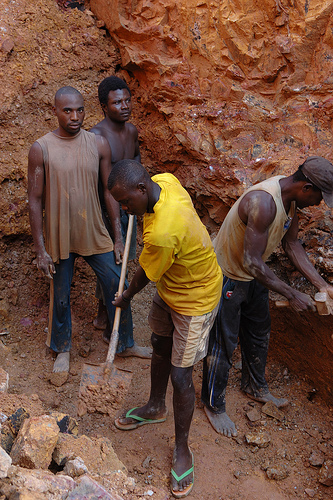
We have been rather quiet in our "Deconstructing Mobile" series as other projects have taken priority. We are picking up the thread again to continue to demystify the many myths surrounding mobiles in development and shed facts, evidence, and data on many of the over-hyped projects and ideas. One area with much hype is the recent debate about "mobiles and rape" in the Congo. Laura Seay, an assistant professor of political science at Morehouse College in Atlanta, Georgia, recently wrote on her blog a great post that looks for actual evidence linking rape and mobiles. We wrote about this campaign a while back already but her post goes deeper in looking at the facts. It is aptly entitled: Show me the Data. We are reposting it here with her permission.
Show me the Data by Laura Seay
A couple of months ago, a certain grad student/atrocity humor blogger who shall remain nameless emailed with the following question: "Could you point me towards anyone who's done research on the linkage / lack thereof between the mineral trade and sexual violence?" It seems that in her graduate school endeavors, solid research requires actual evidence to support the "cell phones/minerals cause rape" thesis that's become quite popular due to efforts of various activist groups, most notably the Enough Project.
It just so happened that this particular email arrived just a few days after I gave a talk on the subject of minerals and violence in the Congo, so I had already been searching for such evidence.
Long story short: there isn't any. As far as I can tell, there has as yet been no published report that systematically demonstrates a rigorous causal relationship between the mineral trade and the epidemic of sexual violence in the eastern Congo.
The Betavine Social Exchange project has taken a step foward today by launching the "Chembe Challenge". The winner will receive a US $5,000 prize and the chance of a further US $5,000 to deploy the solution in the local market.
The Chembe Challenge is all about finding mobile solutions to personal security concerns in urban areas of Africa. The challenge is hosted on the Betavine Social Exchange and anyone can propose a solution but Chembe require that a local partner is engaged in the solution from Kenya, Mozambique, South Africa or Tanzania.
The Betavine Social Exchange seeks to bring together people in the community with ICT challenges and mobile developers or local entrepreneurs that can help solve those challenges. It is important that the solutions have a local link and the way to deploy the solution locally is clear and planned.
After coming back from Amman, Jordan, where we co-hosted a workshop on mobiles, data, and social action, we heard from many of our colleagues who have been blogging about their experience. We also combed through the evaluations and tweet and other social media streams to evaluate this unique workshop. Here are some excerpts.
The workshop was organized by Mobile Active with the goal of bringing new technology to bear on the challenges involved in Iraq's efforts to meet the Millenium Development Goals. We focused on using mobile phones for data collection around child malnutrition and school attendance. The Iraqi government and UNICEF are looking to collect this information so they can better design and target their interventions.
Several participants have blogged elsewhere about the difficulties on the first day of bridging the jargon-gap between the technologists and the development workers. Yes, the geeks spoke too fast and focused too little on storytelling during the first day's Ignite Talks. True, the development folks could have communicated more effectively about the goals of the project or the context in which they were working. As someone who has tried hard throughout my career to straddle these worlds, I can attest to a few painful moments.
But that's not the story here.
When Development Seed was first getting started seven years ago, this sort of event would have been unthinkable. For me the chance to participate in passionate, intelligent, and creative discussions with high-level representatives of a government and the United Nations about how technology can be utilized to solve some of the world's most challenging development problems was amazing. Even better, many of the tools and strategies discussed will be piloted early next year and rolled out in the months following that. This workshop was the real thing. Real decision-makers working with leading technologists to design and implement a project that would be rolled out in the real world on a scale big enough to matter.
We had great discussions about strategies for verifying data, making mapping participatory, visualizing data, and incentivizing participation in crowd-sourced data collection projects. The range and depth of experience of the attendees ensured that the conversations were peppered with examples of previous work conducted across the Middle East, Asia, and Africa. COSIT deserves a lot of credit for their willingness to adopt these tools as well as their active and critical participation in the group discussions. The UNICEF Innovations team also deserves recognition for spearheading the development and deployment of these technologies in a famously slow-adopting UN system. If this is the future, I like it.
Imagine, for a moment, putting a member of the Iraqi Ministry of Planning next to an MIT researcher working on creating distributed micro-networks of peer to peer communication through cell phones. Now say: “You two – go work together for Iraq’s children!”
Does this sound like an impossible task? The Iraqi is concerned about the unique challenges facing their operations. How to build trust in a government among a skeptical population base. How to tackle the problem of daughters being forced into early marriages, and thus never having access to a proper education. How to reduce violent crime by getting kids off the streets. And how to make policy decisions without access to good data, and difficulty coordinating among ministries.
Meanwhile the researcher is thinking about network modeling, asynchronous communication channels, and extracting meaningful information from a vast, complicated space of data.
Neither person has any domain knowledge of what the other person does or is interested in. Throw in a language and cultural barrier on top, and how can these two people possibly be able to work together effectively?
Well this is exactly what happened at the Innovations in Mobile Data Collection for Social Action in Iraq and the Middle East (tumblr, netvibes) workshop last week in Amman.
The key to solving this seemingly intractable problem was, as it often is, the right people. See, it wasn’t just the technophiles and the Iraqis in the room. There was an incredibly broad spectrum of people ranging from the uber-techies, to the tech-for-dev crowd (like us and the Ushahidi guys), to the UNICEF crowd of devs and program managers, to the local and regional UNICEF experts, to the team of ministry officials from Iraq. What this meant was that there was a perfect bridge of communication between every different group, and information flew readily from end to end along this bridge. Everyone in the room contributed to this process.
During the conference’s excellent IGNITE talks, we got an overview of all the different projects being executed around the world, and a picture of how these projects succeed and fail and how they might be brought together began to emerge among the community. At the same time we got to see several of UNICEF’s programs, both tech and non-tech. The convergence of these ideas, with the goal of applying them to help Iraq’s children, was one of the primary objectives of the conference. The ministry officials were supposed to pick and choose from what they saw and decide how best to apply technology for the kids.
But it wasn’t working. The geeks were talking too fast. The translators, struggled with the excessive techo-babble and NGO-acronym-speak. The team from Iraq struggled to keep up. And the techies couldn’t understand what the the team from Iraq needed from them.
This was where the bridge came in. A group broke off from the main session with the goal of framing the discussion in a way that the Iraqi officials could relate to, and providing them an environment to communicate their needs that they were comfortable in. With this bridge in place, each party was able to reach that a-ha! moment where they understood how they could work together.
For the Iraqis it came after an excellent talk about the RapidSMS Malnutrition Project in Malawi by Merrick Schaefer, and then a second presentation (in Arabic!) from Jacob Korenblum on Souktel’s mobile offerings in the Middle East. After a vibrant Q&A session, several of the Iraqis approached me for a RapidSMS demo, and when they saw actual messages coming to and from their cell phones and then showing data on a map they got it. They started talking excitedly about how this could be used in their own programs, and I found it one of the most rewarding moments of the conference.
Likewise, in the last session of the conference the Iraqis presented their visions for potential systems they could build to help the Iraqi children. This time it was the geeks who lit up. A lively discussion of how to build the systems ensued, asking and addressing questions that spanned from the current state of cell phone coverage and costs in the region, to defining specific user and service models, to the unique-to-the-region questions around building the population’s trust and working in an environment where security is a huge concern.
Word visualization of the talks with the Iraqi officials
In this way we were able to expand our small tech-for-dev community’s core of interested parties to both the hard-core techies and the Iraqi officials, and successfully build the bridges of communication to bring the most unlikely of partners together.
We greatly appreciates the thoughtful, smart, passionate people who were able to come together for the three days in Amman to critically and constructively engage, share, and plan together. If this is the future, we like it, indeed.
"Innovations in Mobile Data Collection for Social Action," a workshop co-hosted by MobileActive.org and UNICEF Innovation in Amman, Jordan, featured Ignite Talks -- five minute presentations by inspiring people who are using mobiles for social action -- and interviews with key participants.
Igniting the attendees, Brian Herbert presented Ushahidi, a crowdsourcing platform that allows users to map crisis information from their mobiles. In an interview, JD Godchaux discussed NiJeL: Community Impact Through Mapping, which helps organizations share information and tell stories through maps.
"Innovations in Mobile Data Collection for Social Action," a workshop co-hosted by MobileActive.org and UNICEF in Amman, Jordan, featured Ignite Talks -- five minute presentations by inspiring people who are using mobiles for social action in the Middle East -- and interviews with key participants. Jacob Korenblum describes the work of Souktel in Palestine, and Erica Kochi from UNICEF Innovation, the co-host of the event, illustrates why data collected by mobiles is so important for their work in Iraq.
We will be blogging and twittering this week from a workshop we are co-hosting on Innovations in Mobile Data Collection for Social Action in Amman, Jordan.
Co-hosted by UNICEF’s country office in Iraq, UNICEF Innovation, and MobileActive.org, this three-day gathering is bringing invited experts from around the world together to explore some of the key issues related to using mobiles for data collection and analysis of some of the toughest social issues.
Why are we hosting this event?
With the ubiquity of mobile technology, data collection and monitoring of key indicators from the ground up by affected populations is now possible. Mobile technology in the hands of people can now be more than a person-to-person communication medium but can be used for capturing, classifying and transmitting image, audio, location and other data, interactively or autonomously.
Two of the fastest-growing and popular mobile data collection tools have recently seen some exciting upgrades in newly released versions.
Open Data Kit recently released v1.1 of ODK Collect. Open Data Kit (ODK) is a suite of tools to help organizations collect, aggregate and visualize their data. ODK Collect is powerful phone-based replacement for paper forms. Collect is built on the Android platform and can collect a variety of form data types: text, location, photos, video, audio, and barcodes. ODK Collect can be downloaded in the Android marketplace or here. The developers also have a demo video that describes the new features of the release. Open Data Kit is a member of the Open Mobile Consortium of which MobileAtive.org is a founding member.
Some of the new features of ODK Collect include barcode scanning, image/audio/video capture and playback, editing of saved forms, and device metadata (phone number, IMEI, IMSI) support. GPS acquisition and form processing is a faster, and the developers added review data entry. The user interface has been field tested and reworked to make training and use much easier. ODK Collect also supports question grouping, repeats, constraints, complex logic, and multiple languages.
ODK is currently deployed for HIV counseling with AMPATH in Kenya, user feedback gathering for Grameen's AppLab in Uganda, war crime documentation with the Berkeley Human Rights Center in the Central African Republic, and forest monitoring with the Brazilian Forest Service.
Meanwhile, our friends over at Datadyne have released version 2.0 of their popular mobile data collection platform EpiSurveyor. For some of the very cool GPS features of that, see the video below. EpiSurveyor is a free, user-friendly mobile-phone-and-web-based data collection system. Version 2.0 has many new features such as GPS (users with GPS-enabled phones (like the Nokia E71) can automatically create a "GPS stamp" for every record collected AND automatically see the results on a Google map, all within EpiSurveyor.org), advanced logic, including skip logic; numeric range limits for data entry; and a much better user interface for the web-backend.
EpiSurveyor is used by organizations around the world. One organization, TulaSalud in Guatemala, uses EpiSurveyor for maternal health. The video below (en Espanol) explains how the organization is using the tool.
Video informativo de TulaSalud, sobre la aplicación del sistema de monitoreo epidemiológico aplicado con la tecnología de EpiSurveyor, el cual pretende tener a tiempo real el reporte epidemiológico de las comlunidades.
This guest post was written by Joshua Haynes who is studying for his Masters of International Business, at the Fletcher School at Tufts University. Reposted with Hayes' permission.
Adult literacy in rural areas faces an inherent problem. In Niger, for example, there are no novels, newspapers, or journals in native languages like Hausa or Zarma. The 20% of Nigériens who are literate are literate in French. The vast majority of rural villagers have struggled to maintain their livelihoods since time immemorial without ever knowing how to read a single word. What’s the point of literacy if there is no need for written materials?
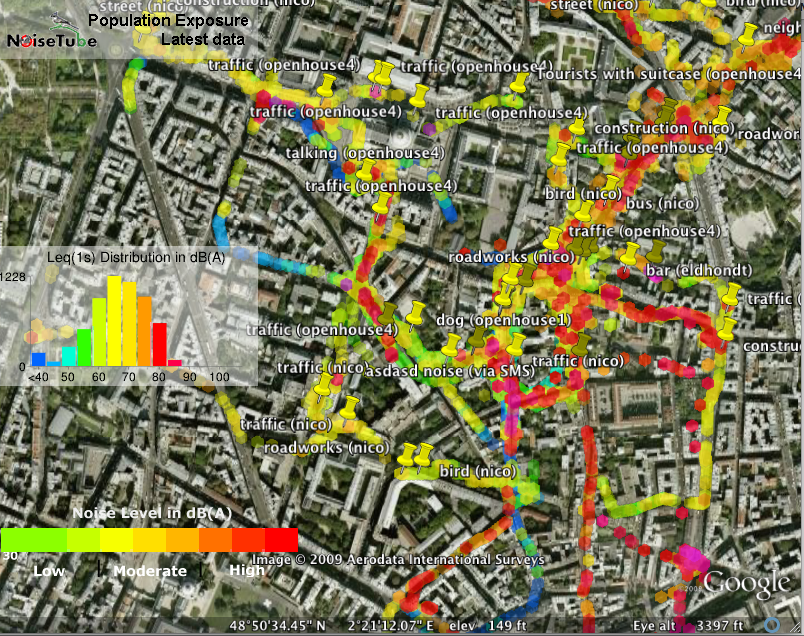
From traffic to construction to everyday chatter, noise pollution is a part of city life. But with the ubiquity of mobiles, documenting noise pollution is getting a little bit easier. NoiseTube and LHR NoiseMap are two projects that use mobile phones to record and map instances of noise pollution.
NoiseTube uses crowd-sourcing to monitor noise pollution. Users with GPS-enabled phones can install a free application that measures the noise level wherever they are. Users tag the recordings with a description of the noise, its source, the time of day, and other criteria, and the data is then mapped onto GoogleEarth; in this way participants can use their phones as noise sensors to automatically share information about their city with other members of the community.
Christelle Scharff is an associate professor of computer science at Pace University in New York. In our occasional series of mobile innovators, she is discussing her work with the Mobile Development and Web Design for Senegal project that teaches students to develop mobile applications.
To date, the project has also trained 22 teachers in Senegal in a training organized with Manobi. Most of the teachers did not previously identify mobile application programming as a field of study. The do now! Take a look at Christelle's work.




.jpg)