March Hare Communications Collective, Inc. (MHCC) is a volunteer mutual benefit corporation that is dedicated to promoting emerging communications technology for the use of public organizing of grass-roots groups and non-governmental organizations. The focus of the March Hare Communications Collective, Inc. is to develop new, secure and open software to be used with existing technologies that will aid community and grass-roots coordination, social networking and organization specifically using mobile technologies. In addition March Hare Communications Collective, Inc. seeks to provide educational materials and trainings on how to use mobile technologies in a safe and effective manner that meets the needs of the user groups. March Hare Communications Collective, Inc. seeks to be a depository of both technologies and information regarding the innovative use of mobile technologies to promote social justice in the US and internationally by grass-root/community groups.
It is believed that once groups acquire information and communication technologies (ICTs), they will prosper. When the most marginalized members of society have better access to information and knowledge, the likelihood of improving their livelihoods also increases. Past literature has dealt with the difficulties that such groups have had in accessing and acquiring technology because of institutional obstacles. This thesis examines the institutional obstacles and constraints faced by groups once they have acquired ICTs.
I intend to examine why, despite the rapid diffusion of ICTs in developing countries over the past decade, there has not been a dramatic improvement in the alleviation of poverty. In particular, this thesis will explore the use of mobile phones in the context of development and poverty reduction in Sub-Saharan Africa and the relationship between institutions and local stakeholders to strengthen livelihoods.
This thesis hypothesizes that development initiatives using a collaborative, hybrid approach that integrates effective institutional involvement with inclusive grassroots participation will be more sustainable and scalable than those that attempt solely topdown or bottom-up approaches. In other words, initiatives devised by institutions that rely upon structures incorporating local communities into projects will be found to be more successful in both the short-term and long-run. Case studies have been selected to illustrate how this hybrid approach is ultimately more successful in improving the livelihoods of the rural poor than approaches that are either primarily driven by the topdown or bottom-up.
The four cases considered in this thesis will describe the extent to which projects or initiatives using mobile phones have been successful in meeting the needs of local beneficiaries and improving their livelihoods.
The Mobile Minute is here to bring you news about YouTube's new mobile site, 4G wireless networks in Russia, mobile phone ownership growth in North Korea, apps and the future of news journalism, and the New York Times' look at the growth of the web.
This paper presents a case study of the efficiency gains resulting from the introduction of electronic technologies to monitor and support adherence to highly active antiretroviral therapy (HAART) in Guguletu, South Africa. It suggests that the rollout of HAART to such resource-poor communities can be assisted significantly by the introduction of modified cellphones (to provide home based support to people on HAART and improve the management of adherence data) and simple barcoding and scanning equipment (to manage drug supplies). The cellphones have improved the management of information, and simplified the working lives of therapeutic counsellors, thereby enabling them to spend less time on administration and to devote a constant amount of time per patient even though their case loads have risen threefold. It has helped integrate the local-level primary health service provision of HAART with the kind of centralised data capture and analysis that could potentially support a national HAART rollout.
Changhong Yang, Jun Yang, Xiangshu Luo & Peng Gong
Publication Type:
Journal article
Publication Date:
1 Jan 2009
Abstract:
Problem Quick detection and response were essential for preventing outbreaks of infectious diseases after the Sichuan earthquake. However, the existing public health communication system in Sichuan province, China, was severely damaged by the earthquake.
Approach The Chinese Center for Disease Control and Prevention set up a mobile phone emergency reporting system. In total, 495 light-powered mobile phones were delivered to local health-care agencies in earthquake affected areas. All phones were loaded with software designed for inputting and transmitting cases of infectious disease directly to a national database for further analysis.
Local setting The emergency reporting system was set up in 14 counties hit hardest by the earthquake in Sichuan province, China.
Relevant changes One week after delivering mobile phones to earthquake-affected areas, the number of health-care agencies at the township level that had filed reports returned to the normal level. The number of cases reported by using mobile phones accounted for as much as 52.9% of the total cases reported weekly from 19 May to 13 July in those areas.
Lessons learned The mobile phone is a useful communication tool for infectious disease surveillance in areas hit by natural disasters. Nevertheless, plans must be made ahead of time and be included in emergency preparedness programmes.
Poor farmers often lack credit to purchase agricultural inputs, and rely on their buyers to provide it. This paper considers the effects of mobile phones on traders of perishable foodstuffs operating between Tanzania’s Southern Highlands and Dar es Salaam’s wholesale market, with a particular focus on the importance of credit in the relationship between potato and tomato farmers and their wholesale buyers.
It argues that the ability to communicate using these new information and communication technologies (ICTs) does not significantly alter the trust relationship between the two groups. It also suggests that farmers, in effect, often have to accept the price they are told their crops are sold for – irrespective of the method of communication used to convey this message – because their buyers are also their creditors. In this situation, many farmers are unable to exploit new mobile phone-based services to seek information on market prices, and potential buyers in other markets. Doing so runs the risk of breaking a long-term relationship with a buyer who is willing to supply credit because of their established business interaction.
It is suggested that, under a more open system than currently exists in Tanzania, mobile-payment (‘m-payment’) applications should target these creditor-buyers as key agents in connecting farmers to the credit they so often require.
Femi Soremekun, managing director of Nigeria-based Biofem Pharmaceuticals, is all too familiar with the fight against counterfeit drugs. In late 2008, a distributor notified him that he suspected that one of Biofem’s products, Glucophage, was being counterfeited. After checking batch and inventory numbers, Soremekun reassured him there was no evidence of such activity. It was only after more allegations surfaced that he sent a sample to French manufacturer Merck & Co. to be analyzed. Turns out the claims were correct. “I was very shocked,” Soremekun says. “[The counterfeiters] got into my market, counterfeited my product, and I wasn’t even aware of it. I was losing sales.”
It was around this time that Soremekun learned about Sproxil, a start-up company that is part of a consortium that includes Nigeria’s pharmaceutical industry association and the country’s regulating agency. The group explores technology-based strategies to tackle drug counterfeiting. On the sidelines of the consortium, Biofem and Sproxil discussed implementing a drug-certification process in order to restore Biofem customers’ confidence in Glucophage. Following a successful five-month trial in Nigeria involving about one million units of Biofem’s product, the company has seen sales pick up again. “We ended up being called the guinea pig,” Soremekun jokes.
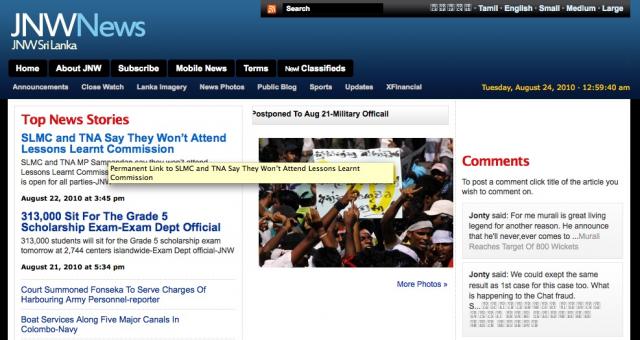
Jasmine News sends between 60 and 90 SMS news updates per month to subscribers on general topics such as politics, law, current events, business, sports, and entertainment. The goal is to provide accurate and speedy news information, for a low fee, to all mobile users in Sri Lanka.
Brief description of the project:
In 2006, Jasmine News began sending SMS news headlines to subscribers in Sri Lanka, the first to do so in the country. Today, the service sends 60 to 90 messages a month to 170,000 subscribers, who pay Rs.30 per month ($0.30) for the service.
Jasmine News provides brief news headlines sent via SMS on general topics including politics, law, current events, business, sports, and entertainment. The organization also has a website, though content is mostly of SMS length. SMS messages are available in multiple languages, including Sinhala, Tamil and Singlish (Sinhala in transliterated English).
To become a subscriber, a mobile user types a code such as "reg JNW" and send its to an established shortcode (2233) to subscribe for the push service. A local number is required.
Target audience:
The target audience is mobile users in Sri Lanka. To receive SMS news updates, a mobile user must subscribe for Rs.30 per month ($0.30). Subscribers must also have a local number, though Jasmine News partners with 6 mobile providers to ensure that news can be delivered to subscribers on any network in the country.
Status:
Ongoing
Anticipated launch date:
What worked well? :
At 170,000, Jasmine News has a notable number of paid subscribers. According to one of the founders, SMS news headlines fill two important needs: inclusion and empowerment through information. And it does so at a price that many people can afford: Rs30 per month.
First, the environment was ideal. With 15 million mobile phone subscribers in Sri Lanka, there was a clear need for an affordable and convenient method to receive news via phone, Ariyadasa said.
Another success for Jasmine News comes from a good working relationship with many telecom operators in Sri Lanka. This ensures that news can be delivered to subscribers on any network in the country.
What did not work? What were the challenges?:
A rather obvious problem for paid subscription-based models is that text messages are easy to forward. But, a founder of Jasmine News said that is not a large issue because while people do forward content, it costs more to forward (at $0.05 per SMS) than to actually subscribe at $0.30 per month for 60 to 90 messages.
Today's Mobile Minute brings you coverage on the Hearst magazine empire's new focus on mobile apps, what can go wrong on your mobile website and how to spot it, a camera phone-to-email project in India, checking African drugs with SMS, and a new speed texting record.