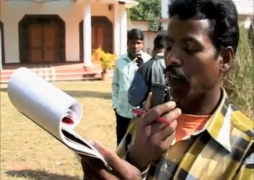
Are Mobile Phones Changing Social Networks? A Longitudinal Study Of Core Networks In Kerala data sheet 908 Views
Author:
Antony Palackal,Paul Nyaga Mbatia,Dan-Bright Dzorgbo,Ricardo B. Duque,Marcus Antonius Ynalvez,Wesley M. Shrum.
Publication Date:
Mar 2011
Publication Type:
Report/White paper
Abstract:
Mobile telephony has diffused more rapidly than any Indian technology in recent memory, yet systematic studies of its impact are rare, focusing on technological rather than social change. We employ network surveys of separate groups of Kerala residents in 2002 and again in 2007 to examine recent shifts in mobile usage patterns and social relationships.
Results show (1) near saturation of mobiles among both the professionals and nonprofessionals sampled, (2) a decrease in the number of social linkages across tie types and physical locations, and (3) a shift towards friends and family but away from work relationships in the core networks of Malayalis.
We interpret these findings as support for the bounded solidarity thesis of remote communication that emphasizes social insulation and network closure as mobiles shield individuals from their wider surroundings.
How can you share information across rural areas with limited or non-existent Internet connections? This is the question that Awaaz.De, an India-based organization that uses interactive-voice-response (IVR) systems to share information on mobile phones, is working to answer.
Co-created by Neil Patel and Tapan Parikh, both at the University of California at Berkeley, Awaaz.De is used by organizations to share information with voice as the primary channel. This could, for instance, take the form of a question and answer service, voice discussion forums, voice surveys, and automated calls.
Because of the open-ended structure of the Awaaz.De platform, the platform has been adapted by very different organizations. Labor Voices uses Awaaz.De to allow migrant workers to review jobs and employers in a voice database; the Development Support Centre uses the service to provide information to small-scale farmers as part of the Avaaj Otalo project (covered by MobileActive.org here), and Galli Galli Sim Sim (the Indian version of Sesame Street) uses the service to allow pre-school teachers to share teaching experiences and information about educational activities.
According to Patel in a post on the ICT 4 Community Health Worker discussion list, there are now eight organizations using Awaaz.De. These organizations have, together, produced more than 100,000 calls from about 10,000 unique callers.
The Internet has enabled people from all over the globe to communicate and share information. Yet over two-thirds of the world’s population remains disconnected from the Internet, and many of these people live in poor, remote areas in the developing world. Organizations struggle to cross the last mile to these communities that are difficult to reach geographically, are often only fluent in local languages, lack reading and writing proficiency, and have limited experience with information technology. Unidirectional broadcast media such as the radio, television, and written periodicals can be localized to a region or community, but they are not micro-local, demand-driven, and do not offer transparent space for feedback and community discussion. Local people may seek information from experts or others in their personal social networks, but misinformation abounds and advice is fragmented across multiple sources. There are few comprehensive, on-demand sources for relevant, high-quality knowledge. This is precisely what the Internet provides for those who have access.
Awaaz.De (“Give your voice”) is a software platform enabling organizations to engage with poor, remote, and marginal communities by providing on-demand, many-to-many information access through mobile phones. People access Awaaz.De applications by dialing regular phone numbers to create, browse, and share voice content through automated voice interfaces. Voice makes it easy to provide services in local languages, overcomes literacy constraints, and offers a low barrier to content creation: one only needs to know how to speak into a phone. Organizations use Awaaz.De to host voice-based information portals, discussion forums, Q&A services, classifieds, and more. For example, rural development organizations can offer demand-driven agricultural extension through a farmer Q&A service, broadcast market prices and weather reports targeted by crop and location, or perform real-time data collection on availability of farm inputs and outputs. In this way, Awaaz.De helps organizations reach previously disconnected people with on-demand, locally relevant information, in their language. Most importantly, Awaaz.De is a social platform that supports people to give their own voice and participate not just as passive consumers, but active producers of knowledge.
Currently Awaaz.De serves eight social development organizations and enterprises across six states in India working in agriculture, education, women’s empowerment, labor rights, and rural products. These organizations serve as content providers, and use Awaaz.De to disseminate their informational content in real time, as well as collect input from the community through interactive features. These organizations have proven the value of Awaaz.De through willingness to pay; partners pay a recurring monthly fee to host their customized voice information service with Awaaz.De
The other demonstration of Awaaz.De’s value comes through the response from the communities of users. To date, Awaaz.De has served over 100,000 calls from over 10,000 unique callers. People rate content highly whenever ratings are solicited; in one deployment, the average rating was 2.8/3 from 325 individual ratings. A bit more anecdotally, unsolicited messages of praise and gratitude come in regularly from people. In a study where an Awaaz.De partner sent agricultural information broadcasts to farmers and then prompted for a question or comment, 37% of the recordings posted were simply comments of praise for the service, compared to 41% posts asking technical agricultural questions. To us, these are small indicators of Awaaz.De's potential for not only building knowledge capital, but social capital. Here’s another good anecdotal example.
Tool Category:
App resides and runs on a mobile phone
Key Features :
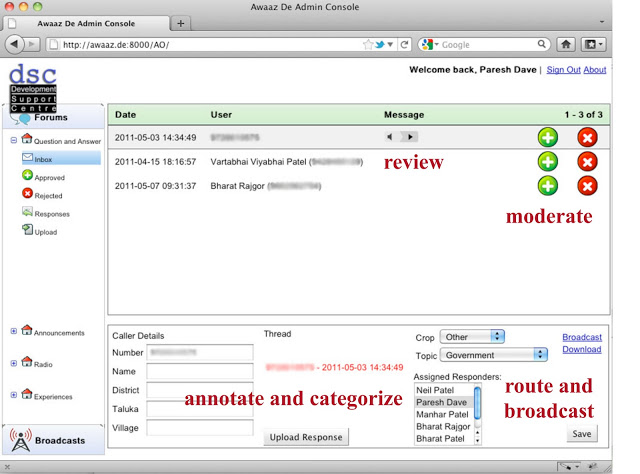
Awaaz.De’s technology platform consists of two components. First, the voice application lets end-users access content through regular phone numbers. After calling in, they navigate automated message boards with touchtone to create, browse, and respond to voice messages posted by others. A “personal inbox” option plays the caller’s own messages, identified by their phone number. Message boards are configured with a number of policy settings. A message board can be listen or post-only, moderated, and allow community response. It can also define sub-message boards based on hierarchical categories. Awaaz.De’s second component is a web interface that lets community managers moderate the voice forums, annotate and categorize content, route messages to specific experts for responding, conduct voice-based surveys, collect ratings, and broadcast the best content to wide (e.g. last 1,000 callers) or targeted (e.g. all callers who have posted messages related to wheat) audiences. Taken together, the two components of Awaaz.De provide an “Internet for the few, voice for the many” model, where the mostly Internet-less community members access content and communicate through mobile voice interfaces, and community managers with access to the Internet administer the system through the web interface.
Main Services:
Interactive Voice Response (IVR)
Voting, Data Collection, Surveys, and Polling
Mobile Social Network/Peer-to-peer
Information Resources/Information Databases
Display tool in profile:
Yes
Tool Maturity:
Currently deployed
Release Date:
2010-09
Platforms:
All phones -- Voice
Program/Code Language:
Java
Python
Other
Organizations Using the Tool:
Awaaz.De is currently being used by eight organizations across six states in India. For their project descriptions, visit this page.
An Exploratory Study on the Use of Camera Phones and Pico Projectors in Rural India data sheet 1974 Views
Author:
Mathur, Akhil, Divya Ramachandran, Edward Cutrell, and Ravin Balakrishnan.
Publication Date:
Aug 2011
Publication Type:
Report/White paper
Abstract:
We explore the potential of using camera phones and pico projectors in rapid creation and presentation of digital content in a development context. A camera phone based content authoring application was designed and deployed with three different user populations in the domains of classroom education and health care.
Our findings show that despite the variations in education levels, cultural background, and technology exposure, users successfully created and presented different forms of digital content using the camera phone and pico projector.
Mobile coverage reaches over 90% of the world's population, but mobile services in traditionally rural, lower-income areas have lagged compared to opportunities in more urban areas. One company in India, Ekgaon, is tapping into the rural market by bringing financial, agricultural, and citizen-oriented mobile services to under-served regions. Vijay Pratap Singh Aditya, CEO of Ekgaon, explained to MobileActive.org how his company developed and evolved over the years.
With a focus on under-served markets, Ekgaon partners with financial institutions, agricultural organizations, NGOs, and corporations to bring mobile services to those who need them. Users of the agricultural system receive personalized and customized soil nutrient management information and crop advice along with weather updates, market information, and alerts; users of the financial services use mobiles to manage savings, remittances, insurance, investments and mortgages; and citizen services allow users to monitor and report on the delivery of government programs.
Apps For Development: Lessons From mPowering data sheet 3211 Views
Non-profit organization mPowering is developing customized mobile apps to help reach the ultra poor -- people living on less than $2 a day -- and connect them with funding opportunities and programs in the developed world.
Reaching individuals and supplying resources in remote regions has huge challenges. The goal of mPowering is to leverage existing mobile infrastructure to open up channels of access. The organization has ongoing programs in Nepal and India which provide incentives to poor individuals for reporting to school or work, via mobile application. The organization is also working to create a mobile donor app to further connect the poor with funding opportunities.
Before a mobile app can be developed and deployed, the mPowering team conducts field research and partners with local institutions. We spoke with Kamael Ann Sugrim, Co-founder and CEO of mPowering, to find out how an app is developed.
Programs in Nepal and India
The mPowering organization is a year old and currently has two programs underway which utilize mobile apps. In Bhaktapur, Nepal, women earn points for reporting to work, and the points can be redeemed for food, clothing, and medicine.
In Orissa, India, 175 children in the village of Juanga earn points for attending school and can redeem the points for food, clothing, and medicine. Teachers have been supplied with donated Android phones with the mPowering application. Through the app, they can “scan” children in for attendance.
Mobile del Mar: How Mobile App Fisher Friend Helps Fishers in India data sheet 3319 Views
An ongoing project in coastal India is working to improve the livelihoods of “fisher folk.” A mobile app called Fisher Friend provides timely information on local fish markets, the weather, and the sea.
A video about Fisher Friend suggests that, “for fishing communities, the key to livelihood is knowledge... knowledge of the market, the weather, and most importantly, the sea.” The Fisher Friend app, which launched in 2007, provides timely and critical information for fishers, and “also increases their knowledge base by providing information on government schemes and entitlements, health services, directory services, and a marine toll-free helpline.”
The Fisher Friend app provides information on potential fishing zones and market rates per species, helping fishers in all phases of their work. MobileActive.org spoke with S. Senthilkumaran, director of MSSRF in Chennai, to learn more about Fisher Friend.
Water is becoming one of the most contested resources in the world as populations increase and the availability of fresh water decreases. MobileActive spoke to the team behind NextDrop, an organization that uses mobile technology to monitor water flow in urban India.
Designed by a team of Berkeley and Stanford graduate students, the idea for NextDrop came out of a class at Berkeley's School of Information on how to use information technology for sustainable development. A group of students wanted to track intermittent water supplies in India. NextDrop was born. Ari Olmos, one of the team members running NextDrop, explains, “There was an opportunity to use information technology to improve the situation and create a schedule and feedback loop.”
This guest post was written by Nithya Sambasivan, a Ph.D candidate in the Department of Informatics at the University of California, Irvine. A link to the complete paper (PDF) is here.
I spent a total of three months last summer conducting an ethnographically-inspired study of urban sex workers (USWs), where we designed, implemented and evaluated a phone-based broadcasting system for urban sex workers. I "hung out" at the solicitation locations and the drop-in shelters of Pragati, called Swati Manne. These Swati Mannes were not only places to rest for the USWs, with beds and TVs, but they also included a medical clinic and a payment area for MFI loans. The internship project was with Microsoft Research India. None of the interviews were audio-recorded. Only hand-written notes were taken.
The Mobile Minute is back to bring you the latest in mobile and development news! Today we have coverage on what 4G really means, the rise of videos on mobile devices, Vodafone's launch of m-banking services in India, a breakdown of what sort of data and research is missing in a lot of conversations about the impact of mobile devices in the developing world, and why you should password protect and encrypt your smart phone.
NPR has an interview with Engadget's Chris Ziegler, who explains why some 3G technologies are being marketed as 4G and how these new networks differ from traditional 3G. He also covers the benefits of market competition, hindrances to fast wireless broadband access, and why 2011 will be the year of the smartphone in the U.S..
The growth of video viewing on mobile devices (Poynter reports that "more than 200 million YouTube videos are viewed on mobile devices each day") has led to a huge jump in the mobile advertising market as advertisers try to reach out to new viewer, resulting in expectations of a $1 billion mobile advertising market for 2011.
Consultation Paper on Certain Issues Relating to Telecom Tariffs data sheet 1197 Views
Author:
Bhawan, Mahanagar Doorsanchar
Publication Date:
Oct 2010
Publication Type:
Report/White paper
Abstract:
Service providers periodically publish different tariff offers with the objective of both customer acquisition and customer retention. Transparency in the provision of telecommunication services and tariff offers has always been and continues to be of prime concern to the Authority. TRAI has in the past taken several steps to enhance transparency in tariff offers. The Authority, however, is receiving several complaints and representations from consumers and their representatives seeking further effective transparency measures. In view of the increased competition as well as the spread of telecom activity to rural areas, the relevance of having a more transparent regime for tariff offerings cannot be overemphasised. At the same time, service providers and their associations have also raised certain concerns. This consultation paper brings out various issues that have a bearing on telecom tariff offers.
Research and Reality: Using Mobile Messages to Promote Maternal Health in Rural India data sheet 1678 Views
Author:
Ramachandran, Divya, Vivek Goswami, and John Canny
Publication Date:
Dec 2010
Publication Type:
Report/White paper
Abstract:
Rural health workers in India do not always have the training, credibility or motivation to effectively convince clients to adopt healthy practices. To help build their efficacy, we provided them with messages on mobile phones to present to clients. We present a study which compared three presentations of persuasive health messages by health workers using a phonebased lecture-style message, a phone-based dialogic message that elicits user responses, or no additional aids.
We found that dialogic messages significantly improve the quality of counseling sessions and increase discussion between health workers and clients; however, we did not statistically measure an effect of either phone-based message on health behavioral outcomes. We analyze these results in light of the challenges we faced and compromises we made through the research process due to the interplay of social, cultural and environmental realities, and discuss how these factors affect ICTD projects at large.
Nearly 1.6 billion people in the world live without access to electricity. This is a quarter of all humanity. At the same time, off-grid power stations from mobile towers often produce excess energy.
A new initiative from the GSMA Development Fund in partnership with Lighting Africa, International Finance Corporation and World Bank, seeks to combine this lack of electricity with excess power from mobile stations. The resulting project is called the Community Power from Mobile (CPM) initiative.
The initiative will support and encourage mobile network operators and tower-sharing companies in developing countries to provide excess power generated by their base stations to local, off-grid communities. This power can then be used for anything from charging handsets and lanterns to powering local schools and clinics. Case studies already exist and the CPM initiative is setting out to test a business model for future deployments, said David Taverner, director for the Green Power for Mobile (GPM) program at the development fund.
MobileActive.org spoke with Taverner to learn more about the goals of the initiative.
Today's Mobile Minute brings you news about the six organizations that won social networking grants from infoDev, the way mobile advertising is used in Europe, the launch of 4G networks in Africa, accusations of rigging in India's bandwidth auctions, and a CGAP series that de-hypes mobile banking with actual data.
InfoDev announced the winners of its social networking grants for organizations working in Africa and Asia. The winners were Akirachix (Kenya), MoMo Kampala (Uganda), COSTECH (Tanzania), Mobile Monday (Mozambique), CRC Topica (Vietnam), and Young Innovations Pvt. Ltd. (Nepal). The winners received $35,000 U.S. as part of the Creating Sustainable Businesses in the Knowledge Economy program.
Today's Mobile Minute's coverage will feature release of the data-aggregating program SwiftRiver, feature phones' allure in developing countries, Nokia's entrance into the dual SIM card market, a new book that investigates how ICTs will have an effect on politics and culture in the Muslim world, and how RIM's response delayed India's proposed ban on BlackBerry services.
From Bollywood to BBC, Bubbly is a Voice in the Audio Blogging World data sheet 8209 Views
Bubble Motion, a provider of mobile messaging and social media applications, launched Bubbly this year in India, making strides in the mobile audio blogging world. Audio blogging is a form of blogging in which the medium is audio content. Bubbly works by call and record, and thus can be adapted in areas with high mobile penetration and low Internet access, such as India.
A Bubbly user calls the service and through an integrated voice response (IVR) menu can record a name and message, usually less than 30 seconds. When other users choose to follow a user’s posts (or “Bubbles”) they receive an SMS message every time new audio content is added. A video by Pi Social Media on YouTube demonstrates how to record and listen to a Bubble; this one about an office party meet-up.
MobileActive.org spoke with Bubbly and the BBC, a user of the service, to find out how it works.
Today's Mobile Minute brings you coverage on how mobiles are helping farmers in India, jquery on mobile, a comparison of patterns between mobile and desktop Twitter usage, and a mobile-only magazine.
We've got news on Saudi Arabia's and the United Arab Emirates' moves to ban BlackBerry, the release of the TakingITMobile mobile youth activism survey, a review of livestreaming services for mobiles, USAID's mobile financial services risk matrix, and a report that reveals the niche uses for location-based mobile services.
India is a country of villages, with over 70% of its population living in rural areas. For mobile operators, this means future mobile subscribers in the country are going to come from India’s villages.
Between 2002 and 2006, mobile penetration increased by a more than 40% in India (source ITU). Still, rural penetration is low, making up just over one fifth of the total mobile user base in India, as reported by the Telecom Regulatory Authority of India in 2007. The future of the mobile industry is exanding in rural India, but what do mobile operators need to do to tap into this market?
In 2009, Accenture, a global management consulting company, surveyed 2,400 current and potential rural consumers and interviewed 15 senior-level executives representing the mobile telephony ecosystem. The goal was to understand the needs of rural customers for mobile services and identify the value propositions for rural services by mobile operators.
We have another new case study up where we report on an innovative audio-based citizen journalism project in Chhattisgarh, India. Tribal citizen journalists have been reporting news in their own languages through a new service called CGNet Swara. CGNet stands for Chhattisgarh Net). The service allows citizen journalists to call in and record news in one of four local languages. The news that has been produced has been picked up in India's mainstream media, and some reports have led to concrete action: in one case, teachers whose salaries hadn't been paid for months were paid after a news report elicited a calling campaign from listeners. We've previously mentioned the project in a short blog post. This much more extensive case study is a part of some work we have been doing on citizen media projects using audio, radio, and mobile
BabaJob: Bringing Jobs to People at the Bottom of the Pyramid data sheet 4561 Views
Finding a job is hard but in India, BabaJob is making the process a bit easier for job seekers at the bottom of the pyramid.
Started in Bangalore in March of 2007, BabaJob is a matching resource for blue-collar workers looking for jobs. Sean Blagsvedt, co-founder of BabaJob, explains that the inspiration came from Anirudh Krishna’s research paper “Escaping Poverty and Becoming Poor: Who Gains, Who Loses, and Why?” Blagsvedt learned that most people moved out of poverty through job diversification. However, he noticed that most job-finding resources in India were designed for people seeking white collar jobs. Blue-collar workers and those at the bottom of the economic pyramid had to rely on word of mouth or luck in order to find the jobs that could help them move out of poverty. He decided to create a resource that would allow workers in India to find jobs in their fields and born was Babajob.
Innovation and M-Governance : The Kerala Mobile Governance Experience and Road-Map for a Comprehensive M-Governance Strategy data sheet 3056 Views
Author:
Sanjay Vijayakumar, Sabarish K, Gokul Krishnan
Publication Date:
Apr 2010
Publication Type:
Journal article
Abstract:
The M-Governance project in Kerala, is a comprehensive Mobile Governance project covering ninety odd Government Departments. The objective of the project is to integrate the advancements in mobile technology with various Government departments with an aim to create cost effective, efficient and round the clock Government information systems. The three channels of mobile communication (Voice, Signalling and Data) and a wide range of technologies (Voice Applications, Applications using signalling channel and data service based Applications ) are being used for this purpose. A comprehensive and integrated Service Delivery Platform is being created to roll out the various services and the M-Governance strategy is being formulated.
This paper examines the approach adopted to identify services and design solutions, wherein the primary focus has been to leverage the existing networks and available wireless technologies. The core platforms being used for M-Governance are based entirely on Open Source Technologies.
The paper also tries to present the various challenges faced while trying to implement M-Governance, and the solutions deviced to address some of those challenges, with relevant case studies. The Service Delivery models for various M-Governance Services, some of which have already been frozen, and others that are being considered are also being discussed. The paper also tries to examine the strategy adopted for deployment of these services.
Texting with a Purpose: Catholic Relief Services in India data sheet 4642 Views
Catholic Relief Services' maternal and neo-natal health monitoring program in Uttar Pradesh, India is incorporating mobiles into its work. The pilot project, which launched in June 2009, uses mobiles to increase volunteers' ability to share and gather health information.
The program uses SMSs to allow ASHAs (Accredited Social Health Activists who are local volunteers) to report statistics on maternal and neo-natal health metrics. According to O.P. Singh, who gave a presentation on the program as part of the SHOPS/mHealh Alliance online conference, several problems in the current system led to the adoption of mobiles: the existing paper system was difficult to use, workers at village and block levels had limited access to information from headquarters, and the paper system was slow. The organization hoped that incorporating mobile phones would give the volunteers a better sense of the health landscape, since they would have access to real time information and be able to instantly share their results. During the presentation, Singh illustrated the system with the following graph:
There are two new projects in India that are taking advantage of the ubiquity of mobile phones and cheap voice calling there in order to get news to rural villagers. Widespread illiteracy makes newspapers and SMS alerts inadequate as news delivery systems, and irregular electricity makes television and radio unreliable. Voice calls are also very inexpensive in India, with per-second billing and a downward price-war among the main operators. Voice calls over mobile phones are an easy way for villagers to stay informed.
In the region of Uttar Pradesh, Gaon Ki Awaaz delivers twice-daily news updates via voice calls to villagers in their native Avhadi language. Launched in December 2009, the project now has 250 subscribers spread throughout 20 villages. Read our case study on the project here.
Further south, a similar project is operating among the members of the Adivassi tribe in India. Like Gaon Ki Awaaz, it allows villagers to share and receive news over their mobile phones in their native language (in this case, Gondi). Launched by Shubhranshu Choudhary of the International Center for Journalists, the project focuses on citizen reports with dozens of citizen journalists reporting throughout the region. Watch the video below to see how the project works. For more on audio services, see also our recent scan of projects and tools, Talk to Me: A Survey of Voice-Based Mobile Tech.
These two projects highlight the promise of the mobile phone for targeted news reporting; mobiles can provide cheap, reliable access to hyper-local news that may be more independent than government-controlled media. As mobiles become more common in rural areas, similar projects can provide a way to keep citizens connected.
Anne-Ryan Heatwole is a writer for MobileActive.org
Gaon Ki Awaaz: News Alerts for Rural Villagers data sheet 5756 Views
One call can bring news to hundreds in rural villages in India. Gaon Ki Awaaz, which means “Village Voice” in the Avhadi language, sends out twice-daily news calls to subscribers directly over their mobile phones. Launched in December 2009, the project recently expanded to 250 subscribers spread over 20 villages.
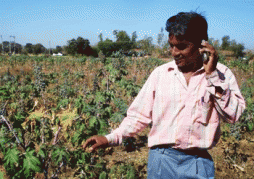

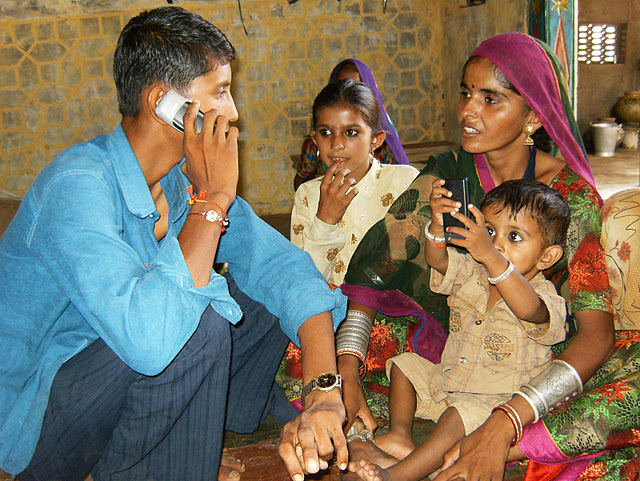
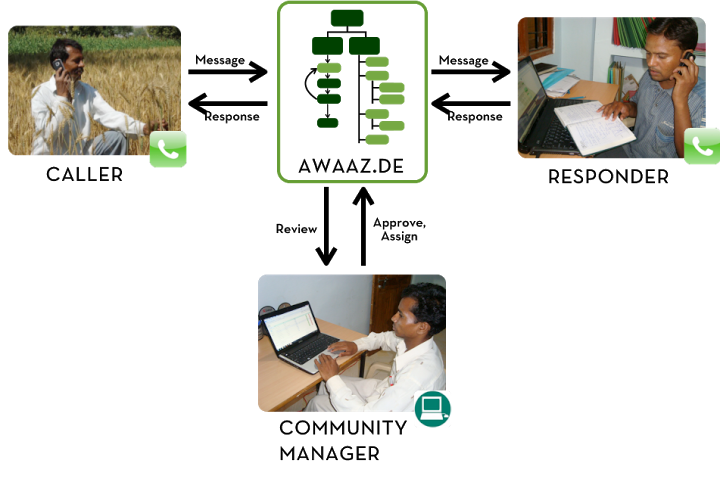 end-users access content through regular phone numbers. After calling in, they navigate automated message boards with touchtone to create, browse, and respond to voice messages posted by others. A “personal inbox” option plays the caller’s own messages, identified by their phone number. Message boards are configured with a number of policy settings. A message board can be listen or post-only, moderated, and allow community response. It can also define sub-message boards based on hierarchical categories. Awaaz.De’s second component is a web interface that lets community managers moderate the voice forums, annotate and categorize content, route messages to specific experts for responding, conduct voice-based surveys, collect ratings, and broadcast the best content to wide (e.g. last 1,000 callers) or targeted (e.g. all callers who have posted messages related to wheat) audiences. Taken together, the two components of Awaaz.De provide an “Internet for the few, voice for the many” model, where the mostly Internet-less community members access content and communicate through mobile voice interfaces, and community managers with access to the Internet administer the system through the web interface.