democracy
Posted by AnneryanHeatwole on Dec 03, 2011
On November 8, 2011, the Liberian President Ellen Johnson Sirleaf won her re-election campaign following a contentious runoff vote. In the October 11 general election, neither of the top two presidential candidates secured a majority vote –Johnson Sirleaf received 43.9% of votes and opposition candidate Winston Tubman received 32.7% of the nation’s votes. Johnson Sirleaf and Tubman were scheduled to participate in a November 8 runoff election; however, Tubman boycotted it saying that the first elections had been unfair; a claim international election observers dispute. As the only candidate, Sirleaf won the runoff despite a low 37.4% of eligible voters coming out for the second round (compared to more than 70% for the first round).
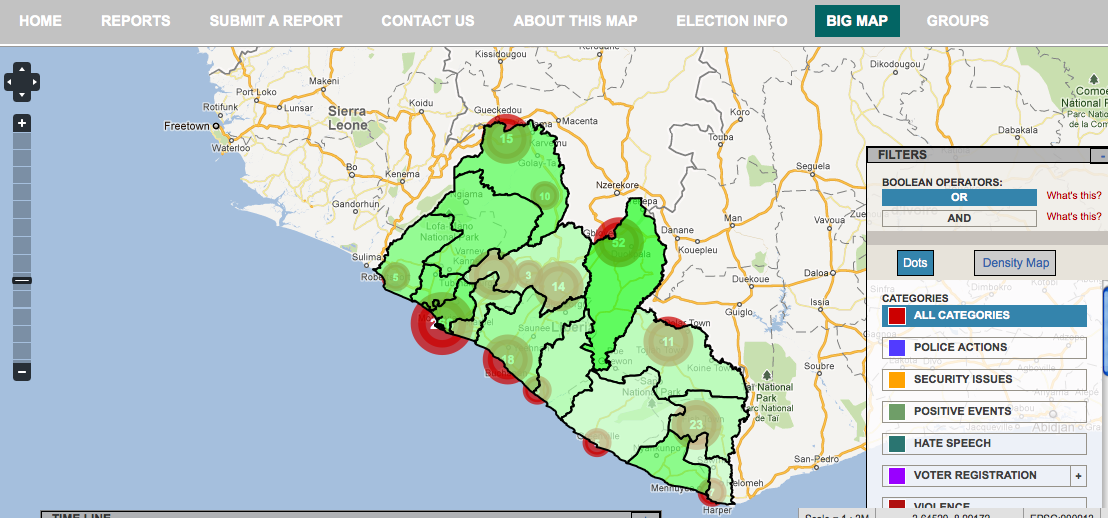
In light of the election’s tumult, MobileActive.org spoke to the National Democratic Institute and Ushahidi Liberia to learn more about their respective work in the country encouraging transparency and fairness through election monitoring and citizen reporting.
The National Democratic Institute and Ushahidi in the 2011 Liberian Elections
Elections can be rigged in many ways, and voter fraud is varied. For instance, ballots can be changed or manipulated, voters can be influenced through intimidation or bribes, violence can shut down polling stations, or ballots can be changed after the election before the results are announced. Technical difficulties can also influence an election by preventing voters from casting their votes or having those votes accurately counted; difficulties could include long lines, failure to open a polling place on time, or a lack of necessary supplies.
| Technology in the 2011 Liberian Elections: Mobiles, Monitoring, and Mapping data sheet 1788 Views |
| Countries: |
Liberia
|
Posted by LeighJaschke on Jun 25, 2009
A Global Empirical Evaluation of New Communication Technology Use and Democratic Tendency data sheet 4890 Views
Author:
Stodden, Victoria; Meier, Patrick
Abstract:
Is the dramatic increase in Internet use associated with a commensurate rise in democracy? Few previous studies have drawn on multiple perception-based measures of governance to assess the Internet’s effects on the process of democratization. This paper uses perception-based time series data on “Voice & Accountability,” “Political Stability,” and “Rule of Law” to pro- vide insights into democratic tendency. The results of regression analysis suggest that the level of “Voice & Accountability” in a country increases with Internet use, while the level of “Political Stability” decreases with increasing Internet use.
Additionally, Internet use was found to increase significantly for countries with increasing levels of “Voice & Accountability.” In contrast, “Rule of Law” was not significantly affected by a country’s level of Internet use. Increasing cell phone use did not seem to affect either “Voice & Accountability,” “Political Stability” or “Rule of Law.” In turn, cell phone use was not affected by any of these three measures of democratic tendency. When limiting our analysis to autocratic regimes, we noted a significant negative effect of Internet and cell phone use on “Political Stability” and found that the “Rule of Law” and “Political Stability” metrics drove ICT adoption.
Posted by CorinneRamey on Feb 26, 2008
MobileActive has aggregated dozens of videos focused on the use of mobile phones in civil society on our new MobileActive YouTube channel.
The MobileActive channel features playlists about mobile phones used in a variety of different fields. On the Mobile Phones in Advocacy playlist, you can watch videos about Greenpeace Argentina's work to pass the Ley de Bosques (Forest Law) by using mobile phones and an advertisement for FishMS, a South African SMS infoline that allows users to text in the names of fish and get a rating about their environmental sustainability. Watch the Mobile Phones in Global Development channel for videos on mobile banking, the Village Phone program, and the growth of mobile phones in the developing world. Check out the Mobile Phones in Human Rights playlist for a variety of videos of human rights abuses taken on mobile phones, including the mobile videos of Egyptian police brutality by blogger Wael Abbas.
Other MobileActive YouTube playlists include Mobile Phones in Citizen Media, Mobile Phones in Disasters and Relief, Mobile Phones in Education and Learning, Mobile Phones in Elections and Participation, Mobile Phones in Poverty Alleviation, and many others.
Check out the new MobileActive YouTube channel and add your videos on the mobile revolution!
Posted by tonyo on Jun 24, 2006
On Monday, June 26, people's organizations and prominent individuals will file an impeachment complaint against Mrs. Gloria Macapagal Arroyo for crimes that include foisting a de facto dictatorship, curtailment of civil liberties, the mass killing of activists and other acts that aimed to cover-up her tracks in the fraud she committed in the 2004 elections.
A vigil has been arranged jointly by the mass movement outside Congress and the congressional opposition so that the said impeachment complaint would be filed ahead of any sham impeachment complaint that may be lodged by allies of Mrs. Arroyo. (Last year, a lawyer was the first to file such a complaint, but it was so weak the opposition had to amend it. Congress rejected the amendments and voted on the basis of the lawyer's week complaint. Nobody wishes the lawyer to mke a repeat.)
Mobile phones are endlessly buzzing, in an effort to mobilize thousands, if not tens of thousands, to form a human barricade just outside Congress. The barricade would start in the form of a vigil starting tonight, and ends with the filing of the impeachment complaint at the opening of Congress' office hours at 8:00 am tomorrow.