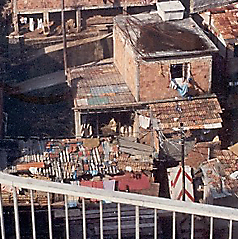
A research study on the role of mobile phones in the slums (favelas) of Rio de Janeiro investigates the power structures of how mobile phones influence social interactions and values among favela residents. Written by Adriana de Souza e Silva, Daniel M. Sutko, Fernando A. Salis, and Claudio de Souze e Silva, "Mobile Phone Appropriation in the Favelas of Rio de Janeiro, Brazil" offers a new perspective on the role of mobile phones in low-income areas. The authors point out that Brazil is in a unique position as it has both high-income and low-income residents living in very close proximity. They say:
Studies of developing countries often exclude Brazil because the country is considered an upper-middle income economy by the World Bank (Donner, 2008), but this classification ignores Brazil’s extremely uneven income distribution (UDNP, 2008), which results in roughly 10 percent of the population earning 46 percent of the overall income, while 50 percent makes only 13.3 percent (IPEA, 2005: 52). Despite this income distribution, there are about 203 million cell phones in Brazil (as of December 2010), making Brazil the fifth largest country worldwide in terms of cell phone absolute numbers, with a 104 percent cell phone penetration rate (Teleco, 2011).
The study's focus on favela residents looks at how mobile phones play a role in both low- and high-income populations.
The study brought together 15 residents from three different Rio de Janeiro favelas (Jardim America, Vidigal, and Mangueira) to discuss how they use mobile phones and how mobile phones are viewed in their communities. The authors highlighted that favela residents live off-the-grid in Brazil; they do not pay taxes and do not receive social services like electiricity, water, or landline phone services. Because the government does not provide infrastructure for the residents, a "parallel" market has sprung up in which favela residents appropriate services from higher-income neighborhoods and redirect them to the favelas. The authors report:
Because favela residents are precluded from corporately legitimized cell phone ownership, they have developed illegal yet easy means for procuring phones while legally avoiding the cost of service and subverting service providers. The clearest example of illegal procurement is the existence of the parallel market: not one interviewee purchased a phone in a store. Phones were either received as presents or purchased from someone in the favela.
The researchers also found that despite Brazil's high phone penetration rate (104%), most of the respondents shared phones among friends and family members. The study participants all indicated that obtaining mobile phones legally was very difficult due to three main barriers: finances, comfort with technology, and difficulty of ownership. The respondents reported that buying a new phone from a legitimate store was out of their price range, signing up for payment plans required a high level of technological savvy, and that the frequent threat of phone theft meant that holding on to a phone in the favelas was difficult.
The paper also researches "diretão," a system of defrauding service providers (which is especially popular among favela drug dealers as it allows them to communicate for free and off-the-grid):
Diretão, as explained by the interviewees, is a phone illegally provided by service provider employees with a special SIM card that allows the user to freely call anywhere in the world for three months. The catch is that, for each individual call, after ten minutes, cell position can be triangulated by the provider, which results in disabling the diretão, and possibly capturing the service thief.
The study is an interesting look at how mobile phones play a role in favelas, and how low-income populations adapt mobile phones to fit into their communities.
In the favelas, or slums, of Rio de Janeiro, Brazil, unnamed streets meander through the hillsides. There are hospitals, coffee shops and restaurants, none of which appear on a map, and mail carriers struggle to get letters to homes without addresses.
A new project by Rede Jovem, a Brazilian nonprofit that loosely translates to "Youth Net," seeks to change that. With the help of five young "wiki-reporters" and GPS-equipped mobile phones, the nonprofit is building a map of five Brazilian favelas: Complexo do Alemão, Cidade de Deus, Morro do Pavão-Pavãozinho, Morro Santa Marta and Complexo da Maré. By uploading information to the phones, the reporters are mapping the unmapped, one road and cafe at a time.
Local information and media is one of the areas where mobiles can be an ideal delivery vehicle. Rede Jovem, a Brazilian NGO created 0800 Rede Jovem, or Mobile YouthNet, a project that reaches young people through SMS on their mobile phones with local opportunities and information about what is going on in their communities. Soledad Muniz talked with Alice Gismonti from Rede Jovem about the SMS project.
Mobile phone use is booming. There are close to 3.5 billion mobile phones in use, and mobile penetration rates are increasing quickly, especially in developing countries. This rise of mobile phone use by low-income and so-called 'base-of-the-pyramid' users raises a number of questions. Are low-income people using mobile technology in different ways than their higher-income counterparts? How can mobile phones be desiged and used in ways that are useful to these populations? Two new studies--one of favelas in Brazil and the other of a low-income township in South Africa--seek to answer these questions.
Two upcoming conferences will address issues relating to mobile phones in development.
The International Development Research Centre (IDRC), a Canadian organization focused on helping organizations in developing countries use technology, will be hosting a conference on mobile phones used to improve access to health services in Latin America and the Caribbean.
The conference will be held on March 17 and 18 in Florianópolis, Brazil. More information is available on the IDRC website.
A WC3 workshop on the "Role of Mobile Technologies in Fostering Social Development" is currently accepting proposals. According to the website, "The goal of the workshop is to understand specific challenges of using mobile phones and Web technologies to deliver services to underprivileged populations of developing countries."
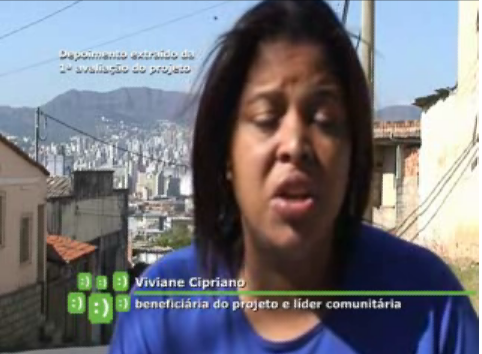
A community SMS news program -- Alô Cidadão! (Hello Citizen! -- brings information about jobs, educational and cultural events, and local news to low-income people in Belo Horizonte in southern Brazil. The messages have been overwhelmingly popular -- over 90% of subscribers forward the SMS to family or friends and rely on the text messages for daily information. Watch our video interview, taped at MobileActive07 in Sao Paulo Brazil. The video, shot on a Nokia N95 mobile phone, features Alô Cidadão! coordinator Daniel de Araújo and interpreter Mary Anne Matos.
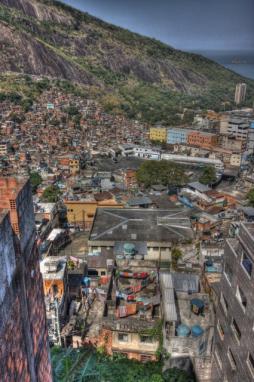
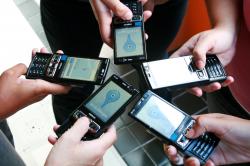 In the favelas, or slums, of Rio de Janeiro, Brazil, unnamed streets meander through the hillsides. There are hospitals, coffee shops and restaurants, none of which appear on a map, and mail carriers struggle to get letters to homes without addresses.