CoolComply: Using Wireless Tech to Monitor Medication Storage and Adherence data sheet 2080 Views
Many medications lose efficacy if stored outside their optimal temperature range, but in rural settings it can be difficult to maintain a steady cooling level. A new solar-powered refrigeration device called CoolComply is working to solve this problem by creating a more stable means of home medication storage, and improving patient adherence along the way.
Developed in partnership by the Massachusetts General Hospital, Innovations in International Health at MIT, and the Global Health Committee, CoolComply uses wireless technology to relay readings to local healthcare workers so they can remotely monitor patients being treated for Multiple Drug Resistant Tuberculosis (MDR-TB).
MobileActive.org spoke with Stephan Boyer (a student of Electrical Engineering and Computer Science at MIT), Anna Young (the R&D Officer for International Laboratories of Innovations in International Health at MIT), and Aya Caldwell (Program Manager at CIMIT’s Global Health Initiative) about their work developing CoolComply.
One of the more interesting mobile apps that I saw at TED, a prestigious tech and design conference in California, projects information from the phone onto any surface -- augmenting information from the web with real life and physical spaces.
The prototype -- dubbed Sixth Sense -- showcased at TED includes a webcam and a battery-powered projector, a small mirror and an internet-enabled mobile phone. The device hangs around the wearer's neck and allows her to summon data and information from the Web on any surface.
Pattie Maes of the lab's Fluid Interfaces group said in her presentation that she and her students are seeking a "new digital "sixth sense" for humans. In the short clips below, Maes' student Pranav Mistry who developed the device, showcases the potential for social interaction and impact.
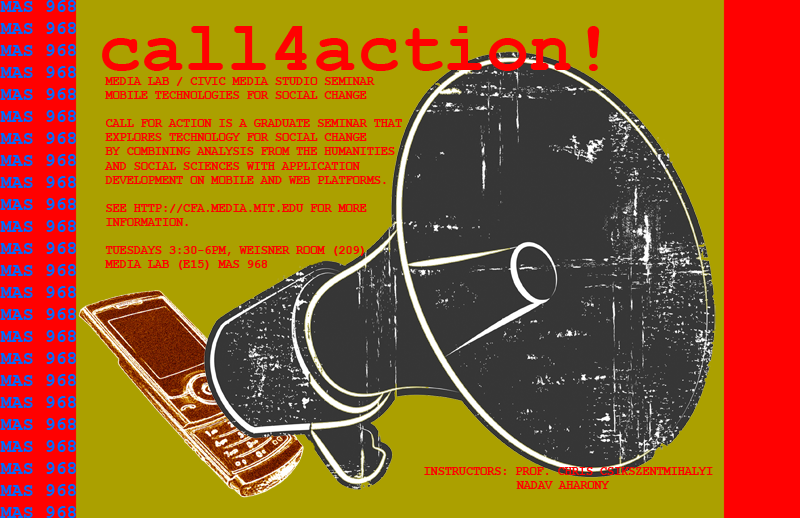
MIT is the first university to offer a graduate class exclusively focused on how mobile phones are used for social action. Call4Action!, the brand-new seminar, asks: How can mobile networked devices be used for social change, politics, and expression? From the course description:
Each week we will review existing tools for social change, cover techniques for mobile hacking, and piece together new experiments. International speakers ranging from Zimbabwean activists to telecommunication experts will discuss the problems with existing ICTs, and suggest parameters for new systems. We'll review protocols, systems, and packages like VOIP, GSM, SMS, and PBX to look at how they may be reused or reconfigured, and explore handset development and alternative communications systems. We will learn to set up, develop for, and hack with systems and open source packages like Symbian Series 60, Android, Openmoko, Django, Asterisk. Through hacking and technical exercises, we will demystify the field and build springboards for future work. By the end of the class, we hope to collaboratively create new repertoires for social change and technical activism.
The numbers should speak for themselves. In 2006, there were 9.2 million new tuberculosis (TB) cases and 1.7 million TB deaths. Of these cases, 5.3% were a tough strain of TB that is resistant to treatment (known as MDR-TB, or multiple drug resistant tuberculosis). The total cost of TB control programs in high burden countries is estimated to be about $2.3 billion in 2008. A team of students and faculty at the Massachusetts Institute of Technology has come up with an innovative response to this problem that uses mobile phones as both a reporting mechanism and incentive program.