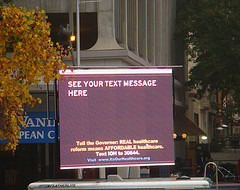
Imagine if every member of the legislature could see a message from your constituents, just by looking out of the window. A text-to-screen campaign allows for exactly this: A large screen, placed right outside the State House, for example, that brings your constituents’ text messages to legislators' eyes.
Not only can people in front of the screen see the message, but anybody can watch a live feed of the messages on a website. "Text to screen allows people in remote locations to interact in a meaningful way with one location," says Jed Alpert of Mobile Commons, a vendor providing a text-to-screen platform.
Individuals interact with the screen by sending a text message or SMS to a short code (a five or six-digit phone number). The SMS is then displayed on jumbatron screen, as well as on a web screen.
MobileActive releases a new guide, How to Run a Text-to-Screen Campaign, that helps nonprofits learn how to run a text-to-screen campaign and determine if this kind of campaign is right for you.
Text to screen can function as a unique way for advocacy groups to use interactive media to
- build a database of mobile phone numbers for future use
- show the opinions and demands of a constituency/the public to decision makers in a highly visible manner
- generate media and public attention
Learn more by reading this new MobileActive guide on the Mobile Advocacy portion of the wiki.



Clever Use
I've mostly been using text to screen for entertainment purposes at places like bars, nightclubs, concerts, and so on. I've never even thought of using it in a political campaign. The only problem though is that constituent comments and messages would most likely be censored before reaching the screen, not portraying a fair display of opinions. Has any well known politician tried this?
TextTheMob.com offers polls as well
I recently played around with http://TextTheMob.com, which let's you set up text-to-screen polls and message boards. It comes as a free version with a shared keyword and premium with advanced features. I used it in a presentation and it my audience loved it. Could be used for a campaign too, I guess.
Mobile Text to Screen Campaigns
You could also take a look at Mozes . It is also easy to sign up for and use and there is almost no spam involved and no hidden rates.
iWall: Text-to-Screen software
You can take a look at www.iwall.com.ar for an inexpensive alternative to implement a text-to-screen system, it's a software package that uses a standard GSM mobile phone to receive SMS text messages and display them on a customizable output screen designed with Adobe Flash.
Post new comment