development

Smartphones for Development

At the turn of millennium, tech journalists (clawing their way back from the Y2k=K non-disaster) found smartphones. Futuristic interfaces, newly-discovered mobility and the work-anywhere promise of the Blackberry kicked off the trend, later boosted by the emergence of high-speed mobile Internet and a new crop of Internet-enabled devices. Market figures are for smartphones are certainly impressive, with Gartner recording device sales of 139.4 million in 2008, up 13.9% from 2007.

That same year, the meteoric rise of the iPhone gave us the ability to purchase third-party smartphone applications through the App Store which became a major selling point for the hardware. In the first quarter of 2009, smartphone sales represented 13.5% of mobile phone sales worldwide. Sales show no sign of slowing, and neither does the blistering pace of innovation in hardware, interfaces and 'ecosystems' like the App Store.
Read More >>


We are all in the Long Tail of Mobile for Social Impact

Ken Banks has a theory: The long tail theory of mobile applications for social development.  It goes something like this, paraphrasing him from his incendiary blog post:

Mobiles are the most rapidly adopted technology in history. But if mobiles truly are as revolutionary and empowering, then don't we have a moral duty in the ICT for Development (ICT4D) community to see that they fulfill that potential?

Banks says that indeed, we do have that moral duty, and I agree with him wholeheartedly there. 

Read More >>


The Mobile Web for Development: Reality and Potential

Reposted from MobileActive08.org, by Brett Davidson

This afternoon I attended 'The Mobile Web': The potential and reality for developing countries, facilitated by Toni Eliasz.

There was extended discussion of the value of the mobile web to developing countries. Views hinge a lot on how one defines 'mobile web'. Some people had strong reservations about the potential of the mobile web, related to affordability, the need for high-end phones in order to browse the internet, the high cost of data access via cellphone networks, and ongoing problems with connectivity.

But many of these reservations can be removed if one defines the mobile web more broadly than accessing the Internet. One person proposed defining it as access to data and databases in whatever form. So if people are able to access data on the Internet, through tailored SMS services, for example, that qualifies as the mobile web.

Read More >>


Development 2.0 - Another Mobile Application Competition

There is yet another competition focused on mobile app development, this time sponsored by USAID and Netsquared. Starting on October 13, Development 2.0 will reward the innovative uses of mobile technologies for international development withup to $10,000 for the winner. While this is less than some of the other recent competitions, applicants can get advice and improve their ideas and clarify their project submissions during the entire application process on a project gallery.

A open voting process will determine the best projects, and then a jury of USAID senior staff will select the final winners. More info is here.

Other compeitions open right now:

Knight News Challenge -- $5 million awarded to digital media projects, including mobile citizen media projects;

Read More >>


The Mobile Web: Limited But Getting Better

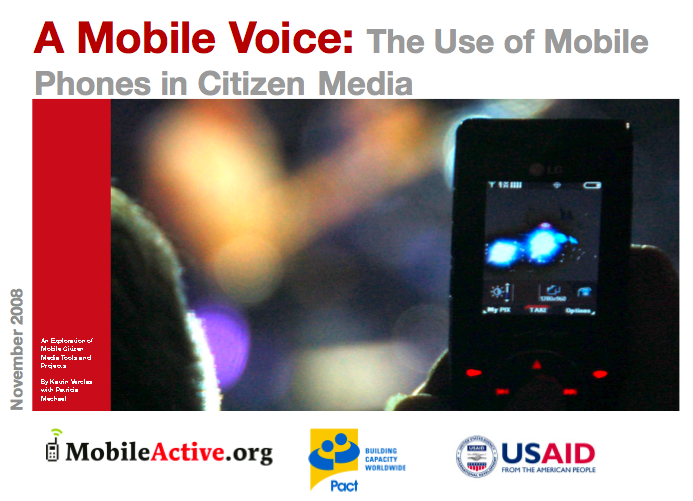
Brough Turner is a renowned telcom industry professional with a passion for mobile and a very smart guy.  We recently interviewed him about the mobile web for a paper on cell phones in citizen media.  What he said is useful for thinking about this in the context for social benefit, so we post it here for you, before the release of our report. We will also have a workshop on the role of the mobile web for social development at MobileActive08.  

You asked me to elaborate on today's mobile web and how it will change with the advent of 3G networks.  Here we go: Mobile phone networks provide the best telephony coverage in the world and, for more than a decade, mobile operators have had a "data" story.  Unfortunately, the data side of mobile telephony has been slow, expensive and limited in what it can access.

Read More >>


Guest Writer Danny Quah: Wireless Technology for Social Change - A Critique

Danny Quah is Head of Department and Professor of Economics at the London School of Economics. I had the pleasure of meeting Danny at the recent release of "Wireless for Social Change: Trends in NGO Mobile Use," in London. This report is an exploration of how mobile technology is changing the way NGOs do their work, and includes case studies of how mobiles are used in social development. Danny had an articulate and cogent critique of our findings. We thought it would be interesting to MobileActive readers to hear his thoughts -- with which I could not agree more -- re-published here with permission.

Read More >>


Woman and Mobile Phones: And who will join this standing up

In 2005, Samsung released a phone designed especially for women. The phone, with a "curvaceous, feminine design" included applications like a fragrance and aromatherapy guide, a shopping list, a calorie counter, a biorhythm clock, and a calendar to help women keep track of their periods. "Almost every woman will desire it," wrote one reviewer, in a piece entitled "High tech for the ladies."

Those marketers and reviewers have it all wrong.

For women around the world, mobile phones are not about sexy designs and knowing when it's that time of the month. Mobile phones are slowly changing the lives of women who use them and the communities in which they live. They've created a path out of poverty for many women in the developing world, as microfinance and "phone ladies" running businesses increase in numbers. Mobiles are enabling translation for victims of domestic violence in the United States, provide Ukrainian sex workers a way to safety, and protect Philippine domestic workers in the Middle East. Mobile phones are giving voice to female reporters in Africa and encouraging free speech in Egypt. And as mobile phones become increasingly ubiquitous -- they're already at 3.3 billion and counting -- they are likely to continue to influence the lives and societies of the women who use them in the future.

Read More >>


Mobile Videos on MobileActive's YouTube Channel

MobileActive has aggregated dozens of videos focused on the use of mobile phones in civil society on our new MobileActive YouTube channel.

The MobileActive channel features playlists about mobile phones used in a variety of different fields. On the Mobile Phones in Advocacy playlist, you can watch videos about Greenpeace Argentina's work to pass the Ley de Bosques (Forest Law) by using mobile phones and an advertisement for FishMS, a South African SMS infoline that allows users to text in the names of fish and get a rating about their environmental sustainability. Watch the Mobile Phones in Global Development channel for videos on mobile banking, the Village Phone program, and the growth of mobile phones in the developing world. Check out the Mobile Phones in Human Rights playlist for a variety of videos of human rights abuses taken on mobile phones, including the mobile videos of Egyptian police brutality by blogger Wael Abbas.

Other MobileActive YouTube playlists include Mobile Phones in Citizen Media, Mobile Phones in Disasters and Relief, Mobile Phones in Education and Learning, Mobile Phones in Elections and Participation, Mobile Phones in Poverty Alleviation, and many others.

Check out the new MobileActive YouTube channel and add your videos on the mobile revolution!


Mobile Anthropology: Younghee Jung on Designing Phones for the Developing World

With mobile phones become ubiquitous in developing countries and emerging markets, phone manufacturers istening to the unique design needs of users there. Younghee Jung , an anthropologist working for Nokia, spoke about the design possibilities for improving phones for the developing world at the LIFT conference in Geneva, Switzerland that addresses the "challenges and opportunities of technology in society."

Read More >>


FORTECH INTERNATIONAL LTD.

Fortech raises awareness on mobile authoring tools that has the capability and capacity to publish, deploy and deliver learning content (anywhere, anytime, anyplace, just in time) with tracking assessments 24/7, 365, accessible by mobile phones, PDAs, and desktop computers. With media applications (images, audio, flash, polling, podcasting, video) all built right into the content.

Read More >>

References / Past Projects

COREMAP Indonesia with NGO                   Energy Philippines to Bring Efficiency Distribution


Fauna & Flora International

Flora and Fauna International uses mobiles in their international conservation and sustainable development work.

References / Past Projects

Fauna & Flora International is the world's longest established conservation society. We work to conserve threatened species worldwide, choosing solutions that are sustainable, based on sound science and take account of human needs.

Additionally, this report is available on the organization's website, www.fauna-flora.org.

Mobile Phones: An Appropriate Tool For Conservation And Development?
Mobile phone technology is developing at an extraordinarily rapid pace and is being applied to an increasingly wide range of human activities and the environment in which we live. It brings both benefits and challenges. This report looks at the implications and applications of mobile phone technology on conservation and development initiatives in the developing world.


Culture of Mobiles In Rural Areas: Beeping, Flashing, Rapelle Moi - and Your Mobile as a Flashlight

The rural mobile market is growing, and carriers are working to meet the unique demands and challenges of this sector of the population. Even in the poorest countries -- like Sierra Leone, which ranks 176 out of 177 countries on the UN's 2006 Human Development Index -- mobile phones have become a growing necessity, creating a unique set of cultural norms and practices.

Read More >>


Mobiles in Development: id21 Profiles Projects and Research

Mobile use and prevalence is exploding throughout the developing world. As Tim Kelly writes in id21 insights's September newsletter, in 1990 there were only 14,200 mobiles in Africa, which by, 2005, grew to a total of 137 million. Id21 predicts that the majority of the world's poor will have mobile access within the next generation. This number continues to increase, showing just how important mobile phones have become in development.

Read More >>


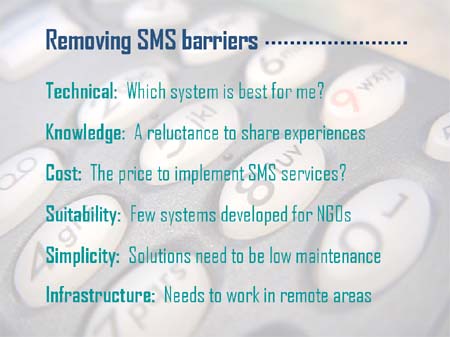
Presentation on the use of SMS in conservation and development

I recently made a presentation at a Conference hosted by Technologies for Conservation and Development (t4cd) at Microsoft's Research Centre in Cambridge, UK.

The Conference, which I helped organise through my work with the lead project partner - Fauna & Flora International - brought technologists and conservationists together to try and join the dots in this 'mini digital divide'. My talk was on the growing use of text messaging within the conservation and development communities, and more generally in wider society.


Read More >>


Find a mobile project.
Find a tool or vendor.
Add your mobile tool, project, or company.
 
 
The Tool in Your Hand: The Mobile Revolution
 
 
Google Groups

Subscribe to MobileActive's Discussion Group

Email:
Visit this group
 
 
Twitter Updates

Twitter Updates

    Follow us on Twitter