MobileActive is announcing the second MobileActive Guide, profiling strategies and civil society organizations using mobile phones in their work to make the world a better place. The MobileActive Guide focuses on using mobile phones in issue advocacy. It features case studies from around the world, strategies for using mobile phones in advocacy work, and a how-to section for advocacy organizations considering using mobile phones to advance their causes.
Mobile phones have become a powerful emerging tool for participation in civil society. This five part series looks ways nonprofits have used mobile phones in their campaigns and the effective strategies deployed, and shares lessons learned.
A Guide to Mobile Security for Citizen Journalists data sheet 15880 Views
Author:
Melissa Loudon
Abstract:
Citizen journalism, and with it the rise of alternative media voices, is one of the most exciting possibilities for mobile phones in activism.
Mobile phones are used to compose stories, capture multi-media evidence and disseminate content to local and international audiences. This can be accomplished extremely quickly, making mobile media tools attractive to citizens and journalists covering rapidly unfolding events such as protests or political or other crises. The rise of mobiles has also helped extend citizen journalism into transient, poor or otherwise disconnected communities.
However, for those working under repressive regimes, citizen journalism can be a double-edged sword. Anything you create and disseminate can be used against you, whether through the legal system or in other more sinister forms of suppression.
This guide for Mobile Security gives an overview and provides recommendations for secure browsing, secure content uploading, and using "throw-away phones" for organizing and communications. We note that secure solutions for mobile communications are currently lacking, however!
Citizen journalism, and with it the rise of alternative media voices, is one of the most exciting possibilities for mobile phones in activism.
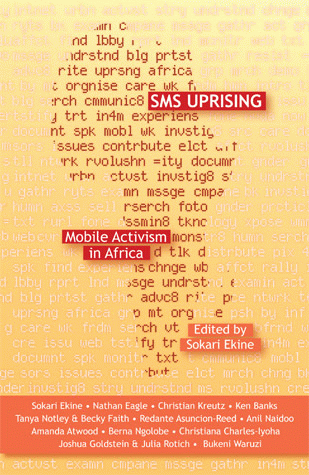
SMS Uprising: Mobile Activism in Africa is a new collection of essays and case studies examining how SMS has been used in Africa for acticism. Essays include Amanda Atwood’s report on Kubatana’s experiences in Zimbabwe setting up mobiles as a means of sharing news outside of government propaganda, to Bukeni Waruzi’s essay on collecting data on children’s rights violations in the Democratic Republic of Congo in 2004. SMS Uprising is published by Fahamu, a British-based organization with a focus on information services for Africa.
SMS Uprising provides the reader with a decent understanding of the state of mobile SMS usage in Africa today. The essays are written by writers, developers, activists, and researchers who are committed to Africa, and cover a multitude of ways SMS can be applied for advocacy work – everything from alerts about political unrest to sharing health information. The book is divided into two parts: context and case studies.
SMS Uprising is significant for many reasons not least because it has been edited by an African woman activist. Often initiatives in Africa are studied by people who are quite distant from the continent or are academics who are remote from the grassroots of the subject under discussion. The book is also unique in giving an insight into how activists and social change advocates are addressing Africa’s many challenges from within, and how they are using mobile telephone technology to facilitate these changes...The intention is that the information contained within the book will lead to greater reflection about the real potential and limitations of mobile technology.
Mobile phones have been a boon to developing countries and to social development. Access to mobiles may indeed allow for better medical information, change the way farmers grow and sell crops, expand the way families interact, influence the way governments treat their citizens, and improve the way students learn in schools. But what is the real story behind these benefits? And who really gains from them? In our ongoing series on Mobile Myths and Realities: Deconstructing Mobile" we turn to how women are or are not benefitting from the ibiquity of mobile telephony. What did we find?
On July 5th, Mexicans will go to the polls to elect new members of the Chamber of Deputies, the lower house of Congress. Two Mexican initiatives, Cuidemos El Voto and Anulo Mi Voto, are using SMS in different ways to make people's voices heard in what they fear will be a less-than-democratic election.
Cuidamos El Voto
By simply sending a text message, citizens will be able to report any voting irregularities or other problems. But Oscar Salazar hopes that Cuidemos El Voto, the vote monitoring system, doesn't receive too many texts.
"We really hope that the number of incidents is low, this will mean Mexican democracy is for real," wrote Salazar in an email interview with MobileActive, who is coordinating the project. "However, if this is not the case, we want to provide NGOs and common citizens with the tools to enforce this process."
Allyson Kapin from Women Who Tech asked me to respond to some excellent questions about mobile campaigns for advocating for specific social issues. As I just received two text messages from NARAL and the Planned Parenthood Federation of America promoting two campaigns they are running, I thought I take the opportunity to answer Allyson's questions publicly, drawing on my experience and observations of the last few years of mobiles in advocacy, illustrating what works and what is better avoided in using mobiles in advocacy campaigns. This is, by nature of the question, somewhat US-centric. A follow-up article will focus on mobile campaigning in the Global South to differentiate some of the key issues.
How can integrating mobile technology benefit online advocacy campaigns?
Mobile social marketing works in increasing awareness and moving people to actions. It is also becoming an effective way to engage users and constituents. Throughout our experience with mobile campaigns, we've run into the some great campaigns and some failures as well. In our ongoing series of articles and case studies on using mobiles for advocating for an issue and engaging a constituency, here are our top ten things that nonprofits should and shouldn't do when running a mobile advocacy campaign.
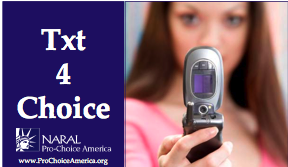
Curious how your state ranks on reproductive choice? NARAL Pro-Choice America makes it easy to find out. By texting the word "grade" and the abbreviation of your state to a short code, you get an almost-instantaneous text response with your state's grade and opportunities for more information. "One of the reasons we decided to invest in mobile technology is we want to diversify how we're communicating with people," said Kristin Koch, Deputy Director of Communications at NARAL. NARAL recently began a mobile program -- they're calling it Txt4Choice -- and has been exploring how to use mobile in ways that compliment and integrate into their already developed communications strategy.
Note: This primer was written for the NTEN newsletter, targeted at a US audience and thus focuses on America. For more on mobile advocacy in many other parts of the world, see here.
Note: This primer was written for the NTEN newsletter, targeted at a US audience and thus focuses on America. For more on mobile advocacy in many other parts of the world, see here.
Mobile phones are more prevalent in the U.S. than ever before. Today, over 86% of the US population ages 13 and up owns a mobile phone. Although Americans say that the mobile phone is the device that they hate the most (it even beats the alarm clock and the television!), the cell phone is here to stay. In the past decade, mobile users have grown from about 34 million to more than 203 million, and growth is expected to continue to increase exponentially.
Polling via SMS can be a unique way to engage current supporters and attract new audiences. Polls can ask any number of questions, from opinions about an organization to views on a controversial issue. However, perhaps the most valuable aspect of polling isn’t the feedback that organizations receive directly from a poll, but rather the relationships with constituents and growing mobile support base that polls can help build.
Organizations engage in mobile polling for two reasons:
to generate a list of mobile numbers to use for future communications and engagement
to get an informal sense of constituent views for use on an organization's web site, for generating media coverage, and learn more about a particular segment of its constituency.
Mobile Phones for Polling and Engagement includes a case study of polls conducted by Media Focus on Africa (MFAF) as part of their Election Assistance Campaign, which sought to promote civic participation and discussion of political issues prior to the December 2007 Kenyan elections. Through SMS polling, MFAF asked its constituents some tough questions.
Should politicians accused of corruption be prevented from vying for political seats? Is tribal identity more dominant than the identity of being a Kenyan? Can voting still deliver credible results after the chaotic party nominations and bribery?
The questions were advertised on television, radio shows, and newspaper advertisements. Thousands of Kenyans responded to the polls via SMS on their mobile phones, helping to bring issues of voting and civic participation into the national conversation.