ict
Posted by neilp on Nov 04, 2011
Awaaz.De data sheet 1422 Views
Organization that developed the Tool:
Problem or Need:
The Internet has enabled people from all over the globe to communicate and share information. Yet over two-thirds of the world’s population remains disconnected from the Internet, and many of these people live in poor, remote areas in the developing world. Organizations struggle to cross the last mile to these communities that are difficult to reach geographically, are often only fluent in local languages, lack reading and writing proficiency, and have limited experience with information technology. Unidirectional broadcast media such as the radio, television, and written periodicals can be localized to a region or community, but they are not micro-local, demand-driven, and do not offer transparent space for feedback and community discussion. Local people may seek information from experts or others in their personal social networks, but misinformation abounds and advice is fragmented across multiple sources. There are few comprehensive, on-demand sources for relevant, high-quality knowledge. This is precisely what the Internet provides for those who have access.
Brief Description:
Awaaz.De (“Give your voice”) is a software platform enabling organizations to engage with poor, remote, and marginal communities by providing on-demand, many-to-many information access through mobile phones. People access Awaaz.De applications by dialing regular phone numbers to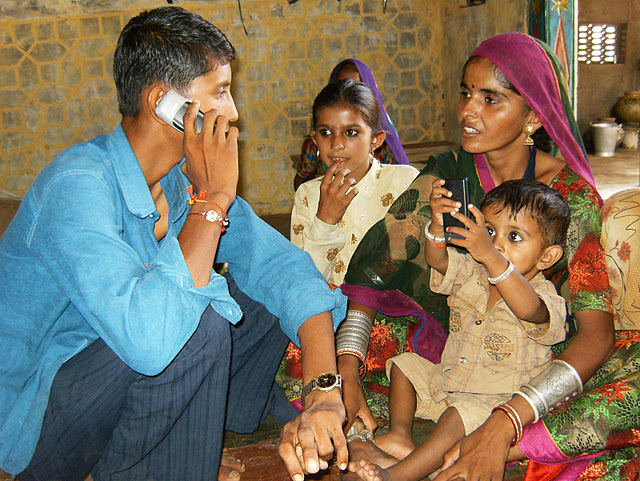 create, browse, and share voice content through automated voice interfaces. Voice makes it easy to provide services in local languages, overcomes literacy constraints, and offers a low barrier to content creation: one only needs to know how to speak into a phone. Organizations use Awaaz.De to host voice-based information portals, discussion forums, Q&A services, classifieds, and more. For example, rural development organizations can offer demand-driven agricultural extension through a farmer Q&A service, broadcast market prices and weather reports targeted by crop and location, or perform real-time data collection on availability of farm inputs and outputs. In this way, Awaaz.De helps organizations reach previously disconnected people with on-demand, locally relevant information, in their language. Most importantly, Awaaz.De is a social platform that supports people to give their own voice and participate not just as passive consumers, but active producers of knowledge.
Currently Awaaz.De serves eight social development organizations and enterprises across six states in India working in agriculture, education, women’s empowerment, labor rights, and rural products. These organizations serve as content providers, and use Awaaz.De to disseminate their informational content in real time, as well as collect input from the community through interactive features. These organizations have proven the value of Awaaz.De through willingness to pay; partners pay a recurring monthly fee to host their customized voice information service with Awaaz.De
The other demonstration of Awaaz.De’s value comes through the response from the communities of users. To date, Awaaz.De has served over 100,000 calls from over 10,000 unique callers. People rate content highly whenever ratings are solicited; in one deployment, the average rating was 2.8/3 from 325 individual ratings. A bit more anecdotally, unsolicited messages of praise and gratitude come in regularly from people. In a study where an Awaaz.De partner sent agricultural information broadcasts to farmers and then prompted for a question or comment, 37% of the recordings posted were simply comments of praise for the service, compared to 41% posts asking technical agricultural questions. To us, these are small indicators of Awaaz.De's potential for not only building knowledge capital, but social capital. Here’s another good anecdotal example.
Tool Category:
App resides and runs on a mobile phone
Key Features :
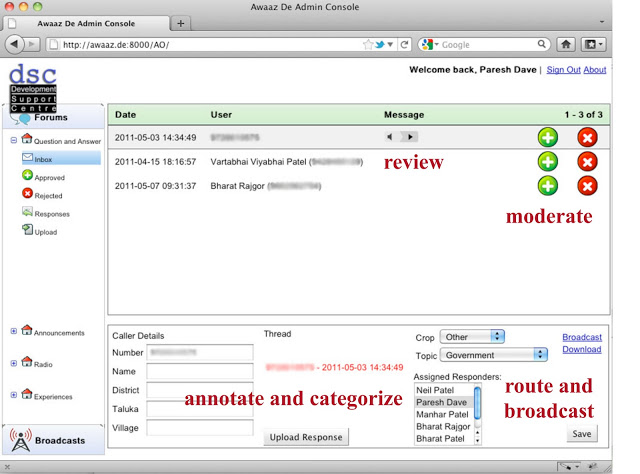
Awaaz.De’s technology platform consists of two components. First, the voice application lets 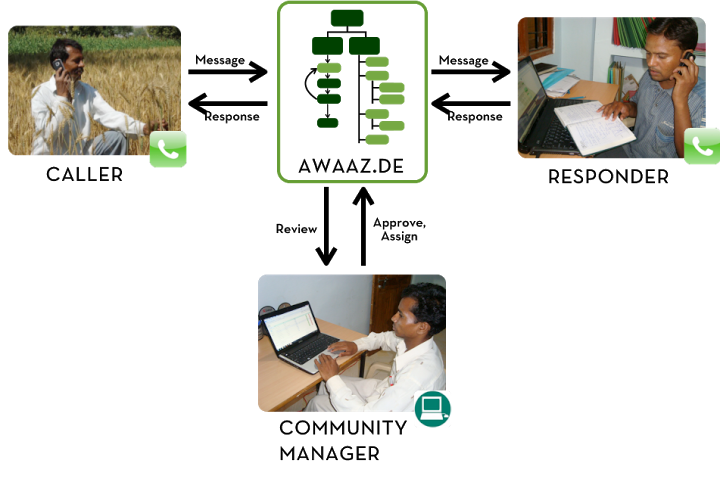 end-users access content through regular phone numbers. After calling in, they navigate automated message boards with touchtone to create, browse, and respond to voice messages posted by others. A “personal inbox” option plays the caller’s own messages, identified by their phone number. Message boards are configured with a number of policy settings. A message board can be listen or post-only, moderated, and allow community response. It can also define sub-message boards based on hierarchical categories. Awaaz.De’s second component is a web interface that lets community managers moderate the voice forums, annotate and categorize content, route messages to specific experts for responding, conduct voice-based surveys, collect ratings, and broadcast the best content to wide (e.g. last 1,000 callers) or targeted (e.g. all callers who have posted messages related to wheat) audiences. Taken together, the two components of Awaaz.De provide an “Internet for the few, voice for the many” model, where the mostly Internet-less community members access content and communicate through mobile voice interfaces, and community managers with access to the Internet administer the system through the web interface.
Main Services:
Interactive Voice Response (IVR)
Voting, Data Collection, Surveys, and Polling
Mobile Social Network/Peer-to-peer
Information Resources/Information Databases
Organizations Using the Tool:
Awaaz.De is currently being used by eight organizations across six states in India. For their project descriptions, visit this page.
Number of Current End Users:
Number of current beneficiaries:
Is the Tool's Code Available?:
Is an API available to interface with your tool?:
Posted by ccarlon on Oct 12, 2011
ICTs for Democracy Information and Communication Technologies for the Enhancement of Democracy – with a Focus on Empowerment data sheet 694 Views
Author:
Association for Progressive Communications
Abstract:
Globally, huge investments are made in ICT as an undisputed and essential component of almost all activities – state and corporate. It is also an integral part of international development cooperation. The rapid spread of ICT – particularly the internet and mobile telephony – is making information available instantly and at low cost to a degree unprecedented in history. It can be used to seek, receive, create and impart information by anyone, at any time and for any purpose. The innovative use of the media has created new forms of citizen journalism which give space to a diversity of voices. In this way, ICT enhances freedom of expression and the right to information, and increases the possibilities for citizen´s participation in decision making processes.
This report examines the potential of information and communications technologies (ICTs) for advancing democracy and empowerment, with a special focus on Kenya, Tanzania and Uganda. Access to and the strategic use of ICTs have been shown to have the potential to help bring about economic development, poverty reduction, and democratisation – including freedom of speech, the free flow of information and the promotion of human rights. Based on signs of current democracy deficits in the case study countries, it is crucial that ICTs be made central to development cooperation and to approaches to advance democracy in the three countries.
Across both urban and rural populations, the predominant tool for communication is the mobile phone, while access to the internet is largely limited to urban areas. The high cost of international internet connectivity – itself a consequence of dependence on satellite connectivity in Uganda and Tanzania especially – means that even within urban areas internet connectivity is the purview of a small well-to-do elite.
Posted by ccarlon on Oct 12, 2011
The Roadmap for Privacy by Design in Mobile Communications: A Practical Tool for Developers, Service Providers, and Users data sheet 785 Views
Author:
Cavoukian, Ann and Marilyn Prosch
Abstract:
Privacy by Design is a concept that is virally spreading around the globe. The powerful concept of engineering privacy directly into the design of new technologies, business practices and networked infrastructure, in order to achieve the doubly-enabled pairing of functionality and privacy, has gained significant adoption by governments, researchers and industry, in any number of sectors. Now that the PbD paradigm has achieved this high level of acceptance, the next major question to be addressed is – how can PbD best be operationalized?
In this guidance document, we focus on the solutions presented by the panellists – in particular, the parties to which responsibility for the implementation of each were assigned. Distinct trends were noted in the types of solution associated with each party, and it became clear that the panellists’ responses could be collected into a practical tool for developers, service providers and users – a Roadmap for Privacy by Design.
Here, we begin by describing the necessity for such a tool in the mobile industry, and then detail the Roadmap, which begins with the Device Manufacturer, travels through the OS/Platform Developer, Service Provider, and Application Developer, and ends with the responsibilities assigned to Users themselves.
Posted by MelissaUlbricht on May 17, 2011
Targeting women with mobile phones and mobile-based projects can bring great benefits and opportunities, as we outlined in Part 1 of our series on women and mobiles. But, there is a “darker side” to this world, which includes changes in gender relations and power dynamic, a potential increase in violence, substitution of money or a change in expenditures, invasion of privacy, and increased control by a male partner.
Changes in Gender Relations and Power Dynamics
When the traditional social dynamic of a household is patriarchal, introducing a mobile phone into the hands of the woman can challenge the existing gender structure. Trina DasGupta, mWomen Programme Director for the GSMA Development Fund, writes in an e-mail to MobileActive.org, “threats to the status quo have sometimes been viewed negatively by community leaders and we have seen examples of this gender discrimination manifesting itself when women gain greater access to empowering tools, such as the Internet or mobile phones.”
Women themselves may not agree. The GRACE project study in Kenya, for example, finds that women do not perceive mobiles at tools for males. “Unlike our literature review that suggested that the mobile phone is culturally construed as a male tool, the women entrepreneurs did not perceive the phone as such. However, the study does indicate that usage of the phone is culturally construed, with an increase in responsibilities and empowerment for one or other profession socially construed as women’s work.”
A paper by Aramanzan Madanda looks at gender relations and ICT adoption in Uganda (the work will soon be published in book format) and finds that “existing gender structures have been dented and that patriarchy is stressed by adoption of the technologies especially mobile phones leading to transformation of gender relations to an extent.”
Posted by MelissaUlbricht on May 11, 2011
A village in India last year banned unmarried women from using mobile phones for fear they would arrange forbidden marriages. The village council suspected young men and women were secretly calling one another to arrange to elope. Meanwhile, unmarried men could use mobile phones under parental supervision.
As mobile penetration increases across the developing world, the entry of mobile phones in the hands of women causes reactions. In many cases, mobile phone ownership empowers women in myriad ways: economic gains, increased access to information, greater autonomy and social empowerment, and a greater sense of security and safety.
But, there is a darker side. Targeting women with mobile phones can cause changes in gender dynamics and family expenditures and may relate to increases in domestic violence, invasion of privacy, or control by a male partner.
Posted by MarkWeingarten on Mar 08, 2011
ICTs and Political Activism - a Zimbabwean Experience data sheet 1665 Views
Abstract:
To counter the Zimbabwean government’s tight grip over the traditional media, activists integrated old fashioned tactics of leaflets, graffiti, and small covert meetings with electronic media: short wave radio, pocket sized video cameras, digital cameras, fax machines, the Internet and email.
An early adopter of this mix of ICTs was Kubatana.net, a locally based non-profit which became an important aggregator of civic and human rights information on Zimbabwe. Its free online archive, established in 2001, offered articles, reports, documents and interviews with much of the information sourced from local civic organisations and international watch dogs. Its electronic NGO directory made civil society organisations accessible at a time when contact details were extremely fluid. Its email newsletter mailing list kept thousands of ordinary Zimbabweans regularly informed of events, opportunities and newly added resources to the web site. And its early adoption of SMS proved crucial to keeping Zimbabweans informed during the critical 2008 elections.
Posted by MelissaUlbricht on Nov 10, 2010
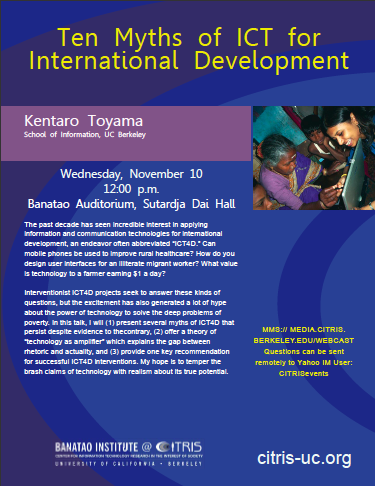
Today at noon PST, Kentaro Toyama will give a talk from UC Berkeley on Ten Myths of ICT for International Development, a topic dear to our hearts as we continue to demystify mobile technology for social change.
A live broadcast is available here. Questions can be sent via Yahoo IM to username: citrisevents.
The Center for Information Technology Research in the Interest of Society summarizes the event here:
The past decade has seen incredible interest in applying information and communication technologies for international development, an endeavor often abbreviated "ICT4D." Can mobile phones be used to improve rural healthcare? How do you design user interfaces for an illiterate migrant worker? What value is technology to a farmer earning $1 a day?
Posted by AnneryanHeatwole on May 04, 2010
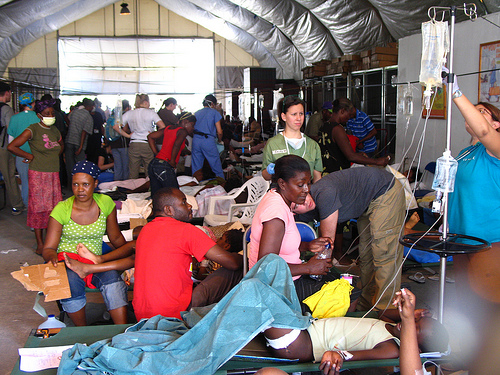
In the days following the devastating earthquake in Haiti in early January 2010, aid workers arrived on the island to offer medical and technical support. With the capital, Port-au-Prince, suffering the brunt of the destruction, transporting supplies and people over destroyed roads proved difficult. Communications technologies, in an immediate post-disaster environment, are critical for aid workers to coordinate relief supplies and to deliver post-disaster care.
| Learning From Haiti: Health IT and Disasters data sheet 3876 Views |
| Countries: |
Haiti
|
Posted by AnneryanHeatwole on Mar 22, 2010
Calling all failures! On April 14 we're hosting the first FAILfaire featuring a close look at ICT and mobile development projects that have crashed, burned, and simply FAILED.
While we often focus on highlighting successes and gains in this field, it's no secret that many projects just don't work - some aren't scalable, some aren't sustainable, some can't get around bureaucratic hoops, and many fail due to completely unanticipated barriers. FAILfaire is a platform to openly and honestly discuss failures so that we can learn from what hasn't worked in the past in order to make our future projects stronger and better.
This is where YOU come in. Have you been a part of a project that flopped? Maybe the project used the wrong technology for its region. Maybe it didn't engage the intended community. Did not take culture, people, or both into consieration. Or maybe the rollout was too rushed. Whatever the reason, we want to hear from you.
| Presenting the First-Ever FAILfaire: Join Us! data sheet 4292 Views |
| Countries: |
United States
|
Posted by AnneryanHeatwole on Oct 09, 2009
Towards an African E-Index: SMS e-Access and Usage Across 14 African Countries data sheet 3339 Views
Author:
Albert Nsengiyumva, Ali Ndiwalana, Beda Mutagahywa, Christoph Stork, F. F. Tusubira, Francisco Mabila, George Essegbey, Godfred Frempong, Ike Mowete, Innocent Ngalina, Lishan Adam, Mariama Deen-Swarray, Olivier Nana Nzepa, Marco Machona, Robertine Tankeu, Sebusang E. M. Sebusang, Sikaaba Mulavu, Steve Esselaar, Tim Mwololo Waema
Abstract:
The SME sector has an important role to play in the present and future economic development, poverty reduction and employment creation in developing economies (Hallberg, 2000). Stern (2002) stresses that the SME sector is the sector in which most of the world's poor people work. SME sector growth largely exceeds the average economic growth of national economies in many countries and contributes significantly to employment creation. Accordingly, governments and donors alike have recognised the important role of the SME sector for overall development. As a result, many government policies are geared towards supporting their growth through a variety of programmes that range from tax incentives to technical assistance; from regulatory provisions to policy interventions; training and other types of business development services (O'Shea & Stevens, 1998).
Arising from this, one of the key issues is to identify the current information practices and needs, as well as the obstacles that SMEs face in their daily business activities, and to provide guidance in creating relevant policy initiatives that will lead to more economic growth and employment. The SME e-Access and Usage survey was carried out by the Research ICT Africa! (RIA!) network in 14 African countries between the last quarter of 2005 and the first quarter of 2006. Its primary objective is to understand the impact of ICTs on private sector development, and how ICTs can contribute to a vibrant SME sector and economic growth in the context of developing economies.
The countries covered included Botswana, Cameroon, Ethiopia, Ghana, Kenya, Mozambique, Namibia, Nigeria, Rwanda, South Africa, Tanzania, Uganda, Zambia and Zimbabwe. To this end, the SME e-Access and Usage survey was motivated by the lack of clarity about the impact of ICTs on small businesses. The literature to date has failed to create a tight link between the use of ICTs and issues such as profitability and labour productivity. There are so many competing claims against government resources and time that a vague link between ICTs and economic growth and employment creation is not convincing enough evidence for governments to commit their resources. This survey aims to change that perception by providing solid empirical evidence of the link between ICTs and business performance based on firm-level evidence.
A major contribution of this survey to the existing understanding of SMEs in Africa is its use of a formality index to categorise SMEs. Past studies have treated formal, semi-formal and informal businesses uniformly, reducing the applicability of their analysis. A formal business is fundamentally different from an informal business in Africa. A formal business pays its taxes, is more likely to export and often is included in official census of SMEs. In contrast, the primary survival strategy of an informal business is to remain below the radar screen, not to pay taxes and not to form part of any official data. Apart from the obvious survey difficulties this presents, there is a more mundane business difference: informal businesses are also more likely to sell or produce anything that might make money, in contrast to more formal businesses that have a tendency to concentrate on a single product or set of products. The implication of this is that a Cobb-Douglas production function, for example, cannot be used to analyse SMEs, unless there is a declared interest only in formal SMEs.
Of course, suveying only formal businesses would be telling half the story since about two-third of non-resource-driven GDP generation is derived from SMEs, and a large share of that from informal ones. The establishment of the link between ICTs and profitability and labour productivity creates another set of policy imperatives for governments across the continent. ICTs are only useful if they can easily be acquired and used. The key obstacle identified by SMEs towards greater possession and use of ICTs is their cost. The high cost of ICTs in Africa has been attributed to policy choices that have limited competition, and the absence of regulatory capacity to regulate abuse of market dominance in wholesale and retail pricing (Gillwald, 2005 and Gillwald & Esselaar, 2004). This requires greater regulatory capacity, something that is missing from nearly all countries included in the survey. To illustrate this, most governments are exclusively focused on the direct contribution of ICTs towards the economy in terms of profits and staff complements of major telecommunications operators.
However, as this report makes clear, it is the indirect contribution of ICTs towards economic growth that is truly transformative: “ICTs have the largest beneficial impact in conjunction with other changes, including a new set of ICT skills/training, structural changes within business models and the economy, and institutional and regulatory adjustments” (ITU, 2006: 39). This means that ICTs have to be looked at from a perspective that considers all causes of economic growth and attempts to provide a catalytic environment that uses ICTs to generate economic growth rather than the ICT sector's specific contribution towards GDP.
Posted by neilp on Aug 11, 2009
Avaaj Otalo data sheet 4811 Views
Organization that developed the Tool:
Problem or Need:
Agricultural information access for small-scale farmers in rural India.
Brief Description:
Avaaj Otalo ("voice-based community forum") is a system for farmers to access relevant and timely agricultural information over the phone. The system was designed in the summer of 2008 as a collaboration between IBM India Research Laboratory and Development Support Center (DSC), an NGO in Gujarat, India.
By dialing a phone number and navigating through simple audio prompts, farmers can record questions, review and respond to others, or access content published by agricultural experts and institutions. In addition to the Q&A forum, Avaaj Otalo includes an announcements board of headline-like snippets updated regularly by DSC staff, and a radio archive to listen to past episodes of DSC's popular weekly radio program.
Key Features :
IVR system for information access and sharing of experiences amongst small-scale farmers in rural India.
Main Services:
Interactive Voice Response (IVR)
Organizations Using the Tool:
Development Support Center
Handsets/devices supported:
Reviews/Evaluations:
Publications:
http://www.stanford.edu/~neilp/pubs/chi2009_patel.pdf
http://www.stanford.edu/~neilp/pubs/slt2008.pdf
Is the Tool's Code Available?:
Posted by PrabhasPokharel on Aug 11, 2009
Radio and ICT in West Africa: Connectivity and Use data sheet 2952 Views
Author:
Malick Ndiaye, Kwami Ahiabenu II, Abdourahame Ousmane, Hippolyte Djiwan, et. al
Abstract:
Radio remains the most appropriate communication medium for social and development communication in Africa. This study consists of carrying out a base-line study of West African radio connectivity to ICT (internet, satellite, computer, digital storage tools, etc.), analyzing the uses implemented, identifying the constraints and opportunities, and making recommendations to the different stakeholders.
The study concentrates on seven (7) targeted countries (Ghana, Benin, Senegal, Mali, Sierra Leone, Burkina Faso & Niger) and concerns all radio stations (public, community, commercial and religious). Two hundred and twenty (220) radio stations took part in the survey. The main tools of research used were questionnaires, interviews and documentary analysis.
The results reveal that overall the average rate of access to the internet by radio stations in the seven (7) countries studied is 51.8 %, with a large disparity according to the country and type of radio. Indeed, while the rate of connectivity is 72.2% for private commercial radio on the one hand, it is limited to 31.5%
for community or non-profit making radio. On the other hand, at a country-wide level, Ghanaian radio has a 93.5% connectivity rate, Senegalese radio 89.7%, whilst only 20% of radio stations in Sierra Leone are connected. In Ghana and Senegal, nearly all commercial radio stations are connected. In addition, 72.7% of Senegalese community radio stations have access to the internet (75% of them have an ADSLline), in contrast to only 8.3% of Nigerien community stations.
The rate of connectivity for all radio stations in Burkina Faso, Benin and Mali, is 61.5%, 55% and 34% respectively. It is thanks to ADSLtechnology that the majority of stations in the sub-region are connected, in particular Senegal, where more than 92 % of stations have access to the worldwide network. As illustrated by the cost of internet access, in certain countries internet use has become more and more accessible, but is limited to regions with good infrastructure.
The strong mobile phone penetration on the continent allows stations to use it as an indispensable tool for reporting and communicating with listeners; this has contributed to today’s large number of radio listeners.
Even though around seventy (70) radio websites have been identified (the majority of them with domain names matching the names of the stations), their presence remains minimal and precarious on the internet. In most countries, live broadcasts on the internet are very unstable (streaming is usually inaccessible) or non-existent, despite being advertised. In addition, a large number of websites have very few - or even no - content.
Mobile value-added services, in particular SMS, used by 83.8% of stations surveyed, have had great success amongst the local population. These new services are considered important tools of interaction between radio stations and listeners and are also a potential source of substantial revenue for radio business.
Convergence between ICTs and radio has brought about results including new multi-use supports which contribute to making radio programmes accessible everywhere throughout the world, and whose coverage, until recently was limited by FM transmitter capacity. The study has shown that in the countries concerned, training in ICTs is not done regularly. In fact, a quarter of the radio stations surveyed stated that their employees have never followed any training. This explains the low level of ICT skills which greatly limits the development of digital products and services in radio stations. Due either to a lack of information or familiarity with ICT, it has also been observed that there is some confusion between free and proprietary software, and even about what kind of internet connection the radio station has.
Posted by LeighJaschke on Jul 14, 2009
Mobile phones may be the right devices for supporting developing world accessibility, but is the WWW the right service delivery data sheet 1151 Views
Abstract:
In this paper we detail the synergies we have observed be-
tween the features and limitations of mobile phones, and the
usability and accessibility requirements of rural developing
world users. This includes support for sequential interac-
tion, multimedia input and output, asynchronous messag-
ing and a universally familiar numeric keypad. However,
we argue that the WWW as currently conceived may be an
inappropriate model for delivering mobile information ser-
vices in this context. We highlight a number of tensions we
have observed between the traditional web model, and the
design synergies that we have uncovered. To demonstrate
an alternative framework, we describe CAM | a platform
for delivering mobile information services in the rural devel-
oping world. Supporting scripted execution, media-driven,
tangible interaction as well as an online usage model, CAM
is uniquely adapted both to rural accessibility requirements
and the inherent capabilities of mobile phones. By learning
from the CAM design, we can either improve the design of
existing mobile web standards and services, or implement a
more appropriate framework altogether.
Posted by LeighJaschke on Jun 25, 2009
A Global Empirical Evaluation of New Communication Technology Use and Democratic Tendency data sheet 4890 Views
Author:
Stodden, Victoria; Meier, Patrick
Abstract:
Is the dramatic increase in Internet use associated with a commensurate rise in democracy? Few previous studies have drawn on multiple perception-based measures of governance to assess the Internet’s effects on the process of democratization. This paper uses perception-based time series data on “Voice & Accountability,” “Political Stability,” and “Rule of Law” to pro- vide insights into democratic tendency. The results of regression analysis suggest that the level of “Voice & Accountability” in a country increases with Internet use, while the level of “Political Stability” decreases with increasing Internet use.
Additionally, Internet use was found to increase significantly for countries with increasing levels of “Voice & Accountability.” In contrast, “Rule of Law” was not significantly affected by a country’s level of Internet use. Increasing cell phone use did not seem to affect either “Voice & Accountability,” “Political Stability” or “Rule of Law.” In turn, cell phone use was not affected by any of these three measures of democratic tendency. When limiting our analysis to autocratic regimes, we noted a significant negative effect of Internet and cell phone use on “Political Stability” and found that the “Rule of Law” and “Political Stability” metrics drove ICT adoption.
Posted by KatrinVerclas on Aug 18, 2008
Civil society can play a large role in getting people digitally connected, say the co-editors of the new book 'ICT Infrastructure in Emerging Asia: Policy and Regulatory Roadblocks'.
"However, in order to reap the full benefits from connectivity in a long-lasting manner, underlying issues of policy, affordability and technology need to be addressed," LIRNAsia's Executive Director Rohan Samarajiva and co-editor of the book with Ayesha Zainudeen, told Mobileactive.org in an email interview.
Currently Asia is the fastest growing region in the world in terms of connectivity. Between 1984 and 1993, the Asia Pacific as a region overtook the other regions of the world (mainly due to mobiles), and it continues to grow, he noted.
"The book looks at the recent experiences of some countries in emerging Asia that are improving connectivity.