In addition to Twitter and mobile phones as a vehicle for economic development, mainstream press and the avant garde public are fascinated with ringtones for good. It is the one topic in mobile campaigns for a cause that consistently get press and attention from mainline journalists. A case in point is the recently featured endangered species ringtones which have the press all, well -- ringing.
Amnesty's campaign to close Guatanamo using SMS has been bothering me ever since I opted in to the mobile action network. Don't get me wrong - the web campaign is great and the pictures and stories on the blog are effective.
But the mobile campaign is all wrong. Yes, mobile campaigns are a new medium, only beginning to show a return, and not well understood. This is even true for big commercial campaigns that are only now sticking their toes into the mobile marketing waters.
But come on, advocacy organization, you are smarter than that. Mobile marketing is not rocket science, there is already a lot we know, and even as you experiment, use some common sense and pay attention to what you already know about engaging users and constituents.
So in order: 1. What's happening in the mobile marketing market that advocacy organizations should pay attention to (caution: this is US-centric!)
Carriers in the US are loosening up their previously tight restrictions on mobile advertising. Verizon, Sprint/Nextel, and AT&T are now allowing banner ads on their landing pages
More and more Americans have WAP-enabled phones, allowing them to do more and more on their cell phones, including watching video and photos, browsing the web, and of course, ubiquitous text messaging. rich media mobile messaging for greater brand and communication impact. Marketers now have at their disposal MMS (define), WAP push (clickable links to WAP-based multimedia content incorporated into SMS messages), and video shortcodes (consumers receive a video stream directly to their handset in response to texting to a shortcode).
Altogether more than 74% of US adults have cell phones -- and they do not leave the house without them (and their keys and wallets - the three things most adults walk around with at all times.)
Sms/texting is growing by leaps and bounds with more than 64.8 billion SMS messages sent in the first six months of 2006, up 98.8% from 32.6 billion in first six months of 2005.
Mobile marketers are salivating, with polls, contests, coupons, and even mobi-sodes, short sms serial stories hitting the commercial market. Pepsi, Ford, Toyota, Burger King all have mobile campaigns, and more and more marketers are allocating hard dollars to "mobile marketing" budgets.
Visa announced its mobile payment platform, allowing cardholders to use their mobile phones to make purchases or conduct other transactions by tapping them against readers. Think 'just in time' fundraising.
But what's the ROI for mobile marketers - such as advocacy organizations?
Everyone agrees, the medium is young, it is risky when poorly done, and it'll take time to judge payoffs. MobileActive's research of existing campaigns shows some interesting returns with sizeable opt-ins, and rather impressive open and forward rates for campaigns conducted by IFAW and Oxfam, for example. We will be publishing more details from specific campaigns in the next MobileActive Guide on Mobile Advocacy.
While a lot of metrics are still elusive, Brandweek reports about a commercial campaign: For the "Everydayrocks" text initiative, some 13,000 people opted in. And more than 75% of the entrants responded to SMS messages from the brand and/or redeemed mobile coupons. Only 4.8% opted out. Most telling, however, was that mobile emerged as the conduit with the best market reach; mobile outperformed radio by more than 64% and billboards by 24%. Overall, the mobile redemption rate was 28%, making it by far the most effective component."
We have seen positive other PR as well - a clever campaign, especially one that goes viral, will get earned media coverage and word-of-mouth exposure
What are advocacy organizations concerned about?
According to Brandweek, there still is considerable "consumer resistance, the main reason behind the carriers' historic refusal to open the gates to ad content." Brandweek goes on: "Studies have shown that consumers are less than thrilled with the idea of receiving ads on their cells. While early adopter teens are among the biggest targets, three-quarters of cell phone users ages 10 to 18 said they do not think it's OK to be marketed to on a mobile device, according to a study of 2,000 users conducted by Weekly Reader Research, Stamford, Conn., on Brandweek's behalf. Forrester Research in Cambridge, Mass., found 79% of consumers are turned off by the idea of ads on their phones and a mere 3% of respondents said they trust text ads."
There are now strict guidelines, drafted by the Mobile Marketing Association, on opt-in and opt out procedures.
It's my phone! Be scrupulous about your opt-in practices, absolutely meticulous in following the mobile marketing code of ethics, and make your vendors follow them to the T. Your brand is at stake, and people will get very annoyed if they perceive you spamming them.
But this is not stopping mobile marketers who are chomping at the bit.
So, what do we know about effective mobile marketing?
Can we talk? 1. Mobile messaging should be about interaction, do not just pitch. A hard notion for advocacy organizations used to pushing email messages by the millions. Mobiles offer a unique opportunity for interaction. Advocacy organizations need to think about mobile marketing as a conversation, a way to interact two-ways with their constituents. 2. Trust is key here as the mobile medium is so very personal. Gain permission and offer relevant and timely content. 3. Pull people to mobile interaction through other media -- ads, billboards, the web and offer, in turn, mobile interaction with those media. 4. Be careful about targeting your demographics and make your ask accordingly -- asking an older constituency to upload mobile photos is probably not going to be very successful. 5. Be relevant. Offer timely news and functional updates that are of interest to your audience-- and be clever. Just by way of an idea: The American Lung Association could offer air quality updates via sms for where I live, for example. In Amnesty's case, I would like to know how many others are signing the petition and how it's going -- what are others saying and how successful is the campaign? Send me an sms with an update since signing on -- I have not heard a lick from Amnesty since I signed the petition two days ago. 6. Mobile marketing works best when it's pull, not push, and there is an opportunity for people to express themselves - to 'talk' back, to suggest, to respond. Humor works here! 7. Be multi-media. Integrate your mobile marketing and messaging into your entire media and messaging campaing; do not let mobile be an add-on - it shows, and it costs you if not done well.
This is a world that is rapidly evolving. Bandwith and technology improving al the time, we will see Internet- and TV-style ads, search, and much more branded content.
For advocacy organizations, mobile marketing is used most effectively for facilitating a dialogue with their constituents. This 'third screen' can create extended conversation, creating connections across online and traditional media exposures.
So what should Amnesty have done better here?
1. Do no ask me for my email to sign the petition, let me do it via sms. 2. Show what people are saying on the petition via sms, in real time on the blog, in ads, in public interest announcements -- in your other media campaign. 3. Tell me back how it is going -- what other people are saying, what is happening. 4. Communicate regularly with me VIA text, BUT remind me of how to opt out. 5. Ask me to forward a note, ask me to make a call, ask me to express myself in a some way in a poll, in a 160 character message, poem or statement. 6. Use humour, allow for humour -- it may be gallows humour in the case of Gitmo, but hey...
Overall: engage me, and do not let me feel that I am sinking in your typical advocacy 'push' hole that benefits you organizationally, but in the end has no impact on the issue, nor engages me in any way.
In the end, because mobiles are so personal, there is a huge opportunity for a conversation that few advocacy organizations used to messaging OUT have any idea how to do effectively. Mobiles are very much a read/write medium in the web 2.0 fashion and only those organizations willing to hear back and engage in 'it's the conversation, stupid' will end up running catchy, creative, engaging, and innovative mobile campaigns.
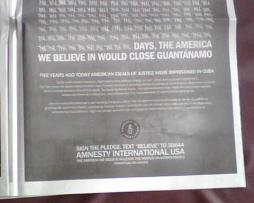
In today's New York Times there is a full-page ad for Amnesty's Close Guantanamo campaign -- complete with a short code for a text-in campaign. Text believe to '30644; to opt in to the Amnesty campaign. This is the frst time that a major campaign is using a text component in their work here in the US. Of course, it's par for the course elsewhere in the world, but organizations have been cuatious here for fear of annoying supporters, and unsure of the ROI of the investment.
The Role of Digital Networked Technologies in the Ukrainian Orange Revolution data sheet 2492 Views
Author:
Joshua Goldstein
Publication Date:
Dec 2007
Publication Type:
Other
Abstract:
This working paper is part of a series examining how the Internet influences democracy. This report is a narrative case study that examines the role of the Internet and mobile phones during Ukraine's 2004 Orange Revolution. The first section describes the online citizen journalists who reported many stories left untouched by "self-censored" mainstream journalists. The second section investigates the use of digital networked technologies by pro-democracy organizers. This case study concludes with the statement that the Internet and mobile phones made a wide range of activities easier, however the Orange Revolution was largely made possible by savvy activists and journalists wililng to take risks to improve their country.
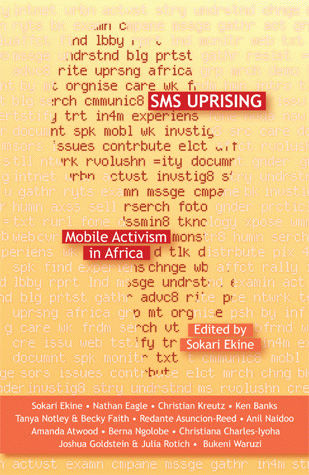
SMS Uprising: Mobile Activism in Africa is a new collection of essays and case studies examining how SMS has been used in Africa for acticism. Essays include Amanda Atwood’s report on Kubatana’s experiences in Zimbabwe setting up mobiles as a means of sharing news outside of government propaganda, to Bukeni Waruzi’s essay on collecting data on children’s rights violations in the Democratic Republic of Congo in 2004. SMS Uprising is published by Fahamu, a British-based organization with a focus on information services for Africa.
SMS Uprising provides the reader with a decent understanding of the state of mobile SMS usage in Africa today. The essays are written by writers, developers, activists, and researchers who are committed to Africa, and cover a multitude of ways SMS can be applied for advocacy work – everything from alerts about political unrest to sharing health information. The book is divided into two parts: context and case studies.
SMS Uprising is significant for many reasons not least because it has been edited by an African woman activist. Often initiatives in Africa are studied by people who are quite distant from the continent or are academics who are remote from the grassroots of the subject under discussion. The book is also unique in giving an insight into how activists and social change advocates are addressing Africa’s many challenges from within, and how they are using mobile telephone technology to facilitate these changes...The intention is that the information contained within the book will lead to greater reflection about the real potential and limitations of mobile technology.
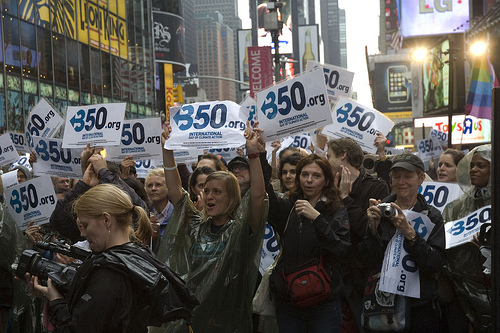
On October 24th, 2009, more than 5200 events in 181 countries took place as part of a climate change awareness campaign. Planned by 350.org, this worldwide festival of events is a call to action.
In December, world leaders will meet in Copenhagen with one critical goal in mind: to create a global treaty to curb carbon emissions. 350.org wants to ensure that the treaty is tough enough to enforce the changes necessary to lower atmospheric carbon levels.
The 350.org name comes from the level of acceptable carbon dioxide –350 parts per million – that can exist in the atmosphere before effects of global warming begin to manifest. Currently, the carbon levels in the atmosphere are at 390 parts per million; 350.org believes that lowering the carbon emissions in the atmosphere to 350 parts per million can help undo some of the damage caused by global warming.
Below are some awards and funding opportunities that we have come across that might be of interest to the MobileActive community. None of the opportunities listed are adinistered by MobileActive; we are just the messenger!
Women in Science Competition Recognising women scientists in sub-Saharan Africa who are "engaged in innovative and pioneering research and communicating the outputs - knowledge, technologies, approaches - for enhancing agricultural performance in sub-Saharan Africa." This competition is also designed for women scientists who are repackaging and communicating existing knowledge to improve the agricultural productivity and livelihoods of rural communities, or who are advocating for policy change to optimise the benefits of scientific and technological developments. Deadline: August 15 2008, more information here.
We are pleased that there is a growing body of academic research on the use of mobile phones in civil society. While primarily focused on mobiles as a tool for economic development (references), we are learning of a few that are explicitly focused on mobiles in activism.
Redante Asuncion-Reed just published his Master's on the use of cell phones in activism focusing on a Fahamu, an African-based organization active in the MobileActive Network. You can download it here.
Ethan Zuckerman has written a solid overview of mobile phones in international activism. It is re-posted here under its Creative Commons license. For additional resources, see also the mobileactive.org Strategy Guides on using mobile phones in elections, advoacy, and fundraising.
"The cell phone has become an integral and, for some, essential communications tool that has helped owners gain help in emergencies. Fully 74% of the Americans who own mobile phones say they have used their hand-held device in an emergency and gained valuable help.
Another striking impact of mobile technology is that Americans are using their cell phones to shift they way they spend their time. Some 41% of cell phone owners say they fill in free time when they are traveling or waiting for someone by making phone calls. And 44% say they wait to make most of their cell calls for the hours when they do not count against their “anytime” minutes in their basic calling plan....
The SMS petition campaign for justice in the Jessica Lal murder case that we wrote about here wrapped up last week with more than 200,000 SMS signatures (previous links no longer active). On air the 24-hour news station NDTV solicited their viewers – mostly middle class and mobile phone owners - to send a text message to the station protesting the injustice they saw in the acquittal of all nine men accused in the fashion model's murder in a crowded bar. These text messages, treated like signatures on a petition, were promised to be sent to the president to show the nation's outrage in what they saw as government corruption and a police cover up.
NDTV's managing editor said, "That just goes to show you technology has changed the face of mobilization completely. Because if this were like ten years ago and you were going door to door collecting signatures, which would have been its equivalent, it would have taken you many more logistics, just an army of volunteers. You didn't need any of that. You needed one rallying point on television."
Control Arms, a joint campaign of Oxfam, Amnesty, and Iansa, is running the 'Million Faces' campaign to push for an international arms trade treaty. Mobile users can upload teir picture and join the petition via their mobile phones in the UK (curiously this is not mentioned anywhere on the site..)
Here is how it works: To join the call for an international arms treaty on a mobile phone, participants text the word 'petition' followed by their full name to a number in the UK (84118) and their name is automatically added to the Million Faces petition. Alternatively, they can upload their picture (to 07955 474747) with their name and age and their photo will be added to the petition.