MobileActive.org recognizes World AIDS Day today, December 1, by featuring some of the organizations and programs that utilize mobile tech in the fight against HIV/AIDS. We hope that countries around the world will continue to fulfill their funding commitments in the fight against AIDS.
Designing SMS Reminders for HIV/AIDS Patients in Peru
SMS reminders are a key component of many mHealth programs targeting drug compliance among HIV/AIDS patients. This slidecast features the findings of Dr. Curioso and colleagues from their research in Peru. The slides address patient recommendations for SMS content and tone, program development, and concerns for cultural appropriateness.
Impact of a mHealth Intervention for Peer Health Workers on AIDS Care in Rural Uganda
This study came our way through a member, Larry W. Chang. Chang et al. evaluated the impact of a mHealth intervention for peer health workers providing AIDS care in Uganda. While the group found no significant difference in health between the study and controls groups, the peer health workers and patients involved showed broad support for the initiative, and improvements in patient care were found.
Text to Change
In our World AIDS Day roundup last year we covered a Kenyan pilot of Text to Change, an SMS-based quiz of HIV/AIDS knowledge. This year we got to learn about two deployments of Text to Change in Uganda.
This guest post was written by Nithya Sambasivan, a Ph.D candidate in the Department of Informatics at the University of California, Irvine. A link to the complete paper (PDF) is here.
I spent a total of three months last summer conducting an ethnographically-inspired study of urban sex workers (USWs), where we designed, implemented and evaluated a phone-based broadcasting system for urban sex workers. I "hung out" at the solicitation locations and the drop-in shelters of Pragati, called Swati Manne. These Swati Mannes were not only places to rest for the USWs, with beds and TVs, but they also included a medical clinic and a payment area for MFI loans. The internship project was with Microsoft Research India. None of the interviews were audio-recorded. Only hand-written notes were taken.
Today, December 1st, is World AIDS Day, a day that is all about raising awareness, countering prejudice, and helping stop the spread of HIV/AIDS. MobileActive.org has put together some of the mobile projects and organizations we've covered recently that are innovating with mobile tech in the fight against HIV and AIDS.
RedChatZone: HIV Counseling via Mobile Instant Messaging Chat
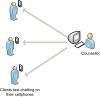
This project is an innovative mobile-based platform for youth and young adults to learn more about HIV and to get support by offering them the ability to communicate anonymously and privately via MXit with a trained counselor.
RedChatZone: HIV Counselling via Mobile Instant Messaging Chat data sheet 7194 Views
In South Africa, the number of cellphones greatly outweighs the number of landlines. The National Aids Helpline (NAHL) is free to call from a landline, but regular cellphone rates apply. This makes the NAHL expensive to use from a cellphone, or people have to make use of public phones which are often within earshot of others.
Cell-Life and LifeLine worked together to make HIV counselling more accessible to young South Africans in a medium which is comfortable and familiar to them. Marlon Parker, who started the successful Angel drug counselling service on MXit, was brought in to implement a similar system.
MXit is a very popular downloadable (instant messaging) chat application, where users can add contacts and text/chat to each other at a very low cost. Without getting into a technical description of the system, here is the basic outline of how the service was created:
Mobile Quizzes For HIV/AIDS Awareness: Zain and Text to Change data sheet 6591 Views
In Kenya, a partnership between the non-profit organization Text to Change and the telecommunications company Zain used SMS mobile quizzes to keep Zain’s employees up-to-date on the latest HIV/AIDS information.
For four weeks in November and December of 2009, Zain’s Kenyan employees were part of a pilot program for SMS mobile quizzes. Employees received three multiple choice questions each week that focused on different aspects of HIV/AIDS such as prevention and treatment. The quizzes also directed participants to testing centers in order to learn their HIV/AIDS status. Says Bas Hoefman, co-founder and managing director of Text to Change, the choice to partner their mobile program with a telecommunications company was logical: “We thought, ‘why isn’t Zain using its own products – mobile telephony and SMS – to educate its own employees?’ Use your own product for your own employees.”
Can text messages help stop the spread of HIV/AIDS? Text to Change (TTC), a Ugandan NGO, thinks the
answer is yes. To prove it they have teamed up with Zain to launch an innovative project that utilizes a technology that has been rapidly expanding to make sure that HIV/AIDS does not do the same.
In our day-long coverage of innovative HIV/AIDS campaigns, here is one from India. The question: How can you encourage men to use condoms to reduce the incidence of HIV/AIDS? The answer: Drive up sales of condoms with an innovative and often tongue-in-cheek multi-media campaign, including catchy ringtones featuring the jingle Condom Condom.
The BBC World Service Trust, the charitable arm of the BBC, has been running a public health campaign in four states in southern India and has now launched a campaign to make clear that "smart men use condoms."
Here is one scene, played out at a wedding: a mobile ringtone buzzes with a loud refrain "condom! condom!" The BBC Trust writes: "Embarrassing for the person holding the mobile phone? Not a bit of it - the reaction of those around the red-faced man is to see him as smart and responsible."
Today is World Aids Day, a day where individuals and organisations from around the world come together to bring attention to the global AIDS epidemic.
Mobile phones are increasinly playing a key role in combatting HIV/AIDS, providing public education and information services, patient monitoring and support, data collection, emergency medical services, and even educational games.
We have written much on this topic, of immense importance to the world where there are now more than 33 million people living with the disease, making it one of the most destructive epidemics in recorded history. Throughout the day, we'll feature a few projects that use or have used mobile technology in HIV/AIDS prevention and treatment that stand out.
Technology-based interventions for prevention and treatment of HIV/AIDS took a small but important place on the agenda at the recent 17th International AIDS Conference in Mexico City, reports attendee Kate Jongbloed who runs an insightful blog on development issues. She reports for MobileActive from Mexico.
In a session entitled, “Reaching Millions: Youth, AIDS and the Digital Age,” a number of private and non-profit organizations presented their internet and mobile phone based approaches to the fight against AIDS. A full audio and video version of the panel can be found here.
In South Africa, mobile phones and HIV/AIDS are two pervsasive realities. Some 75% percent of children and adults in the country have mobile phones, and according to the National HIV Survey, 10.8% of people over two years old are living with HIV. Almost 1,000 AIDS deaths occur every day. Cell-Life, an NGO based in Cape Town, aims to address this growing AIDS epidemic by using mobile phones.
Cell-Life's "Cellphones for HIV" project continues with two new pilot projects. In one pilot, Cell-Life will collaborate with the Treatment Action Campaign (TAC) in the Western Cape to provide information to communicty trainers and the wider HIV community. In the second pilot, Cell-Life will work with Soul City, which uses television and radio dramas to discuss issues such as social norms, health, and HIV/AIDS.
Can I get HIV after having sex for the first time? So goes one of the ten thousand SMS messages that teenagers in Nigeria have sent to Learning about Living.
Learning About Living is a project by One World UK, Nigerian NGOs, the MTN Foundation, and the Nigerian Department of Education using computers and mobile phones to teach Nigerian teenagers about sexuality and HIV/AIDS prevention.
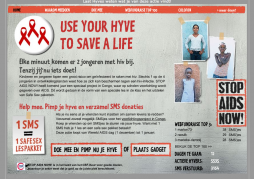
Hyves, the 5-million-peope strong Dutch social network, has a clever HIV/AIDS awareness campaign, combining social network and viral marketing with mobile fundraising.
Use your Hyve to save a Life is a campaign from STOP AIDS NOW!. If you are in the Netherlands, you can send a text message to donate 1 Euro to the campaign.
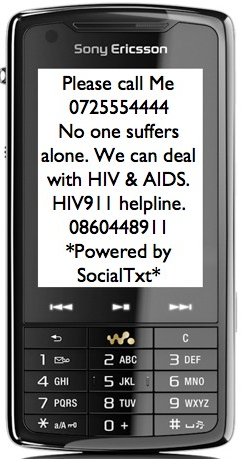
"Please Call Me" messages are a popular cultural form of mobile communication in South African society. These USSD messages are used to advertise everything from car insurance to domestic airlines to the local corner store. Today, thanks to a recent project by SocialTxt, these free messages are used for the first time ever for social marketing: to encourage South Africans to get tested for HIV and obtain AIDS information.
A mobile phone service launched in South Africa this past Saturday provides HIV testing station locations through the use of SMS. South Africans can send an SMS to the short code "31771" with the word "HIV" followed by the name of their town or postal code. The service then responds with the location of the two nearest traveling testing units.
Mobile phones are creating connections between people living with HIV/AIDS in Mexico. A recently completed pilot project called Zumbido allowed its 40 test users of diverse backgrounds to communicate about the daily challenges they face in a meaningful and lasting support network. Unlike other hotline or support mobile phone services, where a user calls one person for help, Zumbido functioned as a network, with each text message sent to every member of the support group.
Mobileactive had a conversation with Anna Kydd, one of the project coordinators of Zumbido. Zumbido -- "buzz" in Spanish -- provided its 40 participants with mobile phones and unlimited text messages. The large group was broken up into four smaller groups of 10. Each group had a mix of different types of people from urban and rural locations, all from the Mexican state of Jalisco. Each group also included a professional doctor or psychologist. "The role of the professional was not to be a sort of leader in the group, however," said Anna. "Everyone in the group was an expert in their own experiences, and they all had something to give that group."
Programs all over the world have shown how mobiles can be an effective tool in providing services to homeless individuals, people with AIDS, and other marginalized populations. Here are a few of the most effective efforts to involve mobiles in innovative ways.
The stereotype is that homeless people don't need mobiles. Why bother with a phone when you can barely afford to put food on the table or don't even have a bed to sleep in? But several different projects have shown that mobile phones can be an important stepping stone in brealing a cycle of poverty. Most importantly, mobiles allow homeless people to get jobs. Employers aren't likely to respond to a resume that lists the phone number of the local homeless shelter, or worse, one without a phone number at all.