Do mobile phones answer all our prayers? I’ve written about the role that mobile telephony can play in humanitarian assistance quite a few times now, without really talking about it directly. The one line I have consistently taken is that cellphone coverage is not reliable or secure enough to be used as the primary means of communication in an insecure environment.
Putting that to one side for a moment, however, it’s clear that mobile telephony really is the key communications technology for the poor - and that means it should be the key communications technology for the humanitarian community.
In the West African nation of Mali, back street vendors power the mobile phone market. The major players -- Ikatel, a division of France Telecom, along with the homegrown Malitel -- have official stores, but most of their sales come from the street. In West Africa, subscription service is rare. Instead, mobile phone users purchase plastic-wrapped cards of varying denominations, scratch off a silvery bar much like those found on an instant lottery ticket, and recharge their phones with the code hidden underneath. These cards can be purchased from tin-roofed convenience shacks, egg sandwich vendors, or random men walking down the street, stacks of soccer jerseys slung over their shoulders.
In Sierra Leone's national election today, 500 election observers at polling stations around the country are reporting on any irregularities via SMS with their mobile phones. Independent monitoring of elections via cell phone is growing aqround the world, spearheaded by a few innovative NGOs.
The story starts in Montenegro, a small country in the former Yugoslavia. On May 21, 2006 the country saw the first instance of volunteer monitors using SMS, also known as text messaging, as their main election reporting tool. A Montenegrin NGO, the Center for Democratic Transition (CDT), with technical assistance from the National Democratic Institute (NDI) in the United States, was the first organization in the world to use text messaging to meet all election day reporting requirements.
Gerry Jackson reports on Media Helping Media about the radio station SW Radio Africa outsisde of London that is sending sms headlines about news in Zimbabwe to it's subscriber base of about 2,000 mobile users. Jackson writes:
"We generate news headlines on a daily basis anyway - so this is just another way of using what already exists.
It’s nice and cost effective for any additional donor because there is only the one cost, actually sending the texts. In two months we’ve built up an address database of about 2,000 mobile phone numbers. Like many, Zimbabweans truly love their mobile phones and of course what we’re banking on is the virus effect.
We also get up to 100 requests a day to be added to the service so it’s growing rapidly. What becomes interesting is what business model to use?
Following on the heels of the BBC feature on the revolutionary growth and availablity of mobile phones in Kenya, OmyNews features a new project-to-be in South Africa's KwaZulu Natal province. The UmNyango Project of Fahamu, a MobileActive participant, equips rural women in the Province with free text messaging to report on violence against them and their children, and report other abuses. The project coordinator, Anil Naidoo, says: ""This is the first time in KwaZulu Natal that we know of, where SMS technology has been used to directly empower women in this way.
Editors Note: We started Failfaire almost two years ago to create a space where it was ok to be honest in our field of "tech for social change," and admit that many projects that we all undertake do not succeed. Today is yet another Failfaire here in New York where practitioners come together to discuss how and why our projects failed. We will be writing about this tomorrow to give you more on the #fails presented, but in the meantime were absolutely astounded today to see the following blog post from Daraja about their Maji Matone project. It takes guts (and foresight) to admit so publicly that this project has not succeeded. We wrote about Maji Matone here before. The project was designed to provide local accountability for water services by way of local, grassroots monitoring via SMS. The post below was oroginally published on Daraja's blog here and is reposted here with Daraja's gracious permission. We are grateful for the post, and for the honesty.
It is no secret that Daraja's Maji Matone programme has not lived up to expectations. In particular, despite considerable resources spent on promotional work - printing and distributing posters and leaflets, as well as extensive broadcasts on local radio - we haven't had the response from the community that we had hoped for. A six month pilot in three districts resulted in only 53 SMS messages received and forwarded to district water departments (compared to an initial target of 3,000). So we've made a decision - to embrace failure, learn and share lessons from the experience, and to fundamentally redesign the programme.
Admitting failure in this way is easy to support in theory, but much harder to do in practice. It may be accepted practice in the for-profit world, but it's uncomfortable for a donor-dependent NGO. Would it be easier to continue half-heartedly with a programme that isn't working or close it down quietly and hope that nobody notices? Of course it would. But those approaches would not benefit anyone, wasting money and missing out on valuable opportunities to learn. So we're taking a different tack, embracing and publicising our failures, and trying to make sure we (and others) learn as much as possible from the experience
Mobiles for Quality Improvement Pilot in Uganda data sheet 934 Views
Author:
Pamela Riley and James BonTempo
Publication Date:
Nov 2011
Publication Type:
Report/White paper
Abstract:
USAID‘s Strengthening Health Outcomes through the Private Sector (SHOPS) project seeks to increase the role of the private sector in the sustainable provision and use of quality family planning/reproductive health and other health products and services. One of the areas of technical focus of the SHOPS project is to identify, deploy, and scale up promising uses of mobile technologies to improve health outcomes. Many developing countries have a severe shortage of health providers, and many of the providers who are working have only limited access to up-to-date clinical protocols, or face-to-face trainings. Mobile phones offer an innovative channel through which to provide cost-effective approaches for clinical training and support for improving quality of care.
SHOPS‘ partners Abt Associates, Jhpiego, and Marie Stopes International (MSI), collaborated in a mobile learning and performance support pilot called Mobiles for Quality Improvement (m4QI) conducted in Uganda during the period September 2010–August 2011. The goal of m4QI was to demonstrate the potential for positive behavioral change in service delivery by reinforcing face-to-face induction training lessons provided to Marie Stopes staff. Research supports the theory that spaced reinforcement of training combined with testing can significantly improve long-term knowledge retention and facilitate behavioral change.
The objectives of m4QI were to develop and test a technology-supported approach to performance improvement including processes for identifying performance gaps in adherence to clinical protocols, a platform to manage and automate the delivery and receipt of text message reminders and quizzes to address the gaps, and production of actionable data to improve effectiveness of supportive supervision and follow-up. To support scalability and replicability, the pilot platform was designed for users of low-end phones, and those without Internet access.
FrontlineSMS is a software platform that enables structured communication via text messaging, using only a computer and a mobile phone or GSM (Global System for Mobile) modem. The platform enables two-way messaging between users and groups of people via mobile networks without the need for an Internet connection.
The purpose of this guide is to provide FrontlineSMS users designing, implementing, and monitoring programs with data integrity concerns in mind with a data integrity framework. The guide is intended to help users to understand, analyze, and address the vulnerabilities, risks and threats that can affect the integrity of the information communicated through the FrontlineSMS platform.
Blacknoise: Low-fi Lightweight Steganography in Service of Free Speech data sheet 1006 Views
Author:
Paik, Michael
Publication Date:
Jan 2010
Publication Type:
Report/White paper
Abstract:
Censorship of communications is a widespread, current practice in various countries with repressive governments in order to prevent or restrict speech; political speech in particular. In many cases state-run telecommunications agencies including those providing internet and phone service, actively filter content or disconnect users in defense of incumbents in the face of widespread criticism by citizens.
In this paper I present Blacknoise, a system which uses commodity low-cost mobile telephones equipped with cameras, and takes advantage of their lowfidelity, noisy sensors in order to enable embedding of arbitrary text payloads into the images they produce. These images can then be disseminated via MMS, Bluetooth, or posting on the Internet, without requiring a separate digital camera or computer to perform processing.
Mobile Communications in Zambia data sheet 750 Views
Author:
Montez, David
Publication Date:
Oct 2010
Publication Type:
Report/White paper
Abstract:
This report uses AudienceScapes data from a nationally representative survey of Zambia to focus on how people of various social groups access and use mobile communications. The report also showcases how the AudienceScapes survey data can help members of the development community to design and implement more effective programs in technological access, communications and information empowerment.
Beyond measuring basic access and use levels, this report works to answer several key research questions regarding the role of mobile phones in economic and social development in Zambia. These include but are not limited to; what is the potential for SMS-based information services as a development tool, is the mobile market beginning to reach disadvantaged parts of the population, what are the continued barriers to mobile phone access and use, who is using mobile money and is their greater market potential for these services?
“SMS for Life“: Use of stock information to improve supply chain data sheet 653 Views
Author:
Barrington, Jim, Olympia Wereko-Brobby and René Ziegler
Publication Date:
Apr 2010
Publication Type:
Report/White paper
Abstract:
Stock-outs of malaria treatments at the health facility level in many sub-Saharan African countries have been a persistent problem for many years. A stock-out is the unavailability of medicine at the health facility. In Tanzania, 93 % of the population are at risk for malaria infection. The number of malaria cases is estimated to be 11 million resulting into 60-80 thousand deaths per year or 220 deaths per day in Tanzania alone. The goal of the SMS for Life pilot project was to develop a flexible and scalable solution to bring up-to-date visibility of anti-malarials within the Tanzanian Public Health Sector with a potential to reduce or eliminate stock-outs of five drugs (four dosage forms of ACTs and Quinine Injectable) in all health facilities in a pilot sample of three districts.
Initiated and led by Novartis, a public-private partnership was established with the Roll Back Malaria Partnership, IBM, Vodafone and the Ministry of Health in Tanzania. This unique partnership developed a solution using mobile phones, SMS messages, internet and mapping technology to visualize weekly stock inventory of Artemisinin Combination Therapy (ACTs) and Quinine Injectable at 129 health facilities and 226 villages. Over the course of one year, the Project Team designed the system, created a data repository, trained key staff and implemented the solution for a 21-week pilot in three districts of Tanzania: Ulanga, Kigoma Rural and Lindi Rural. These districts are located in three different regions and supplied from different Zonal Stores with a catchment population of 1.2 million people.
Mobile phones may be one mechanism to increase effectiveness and efficiency for agricultural extension in low-income countries. Agricultural extension, broadly defined as the delivery of information to small-scale farmers, was developed to counteract information asymmetries suffered by farmers with limited access to information sources like landline phones, newspapers, radios and TV programming. This has meant that farmers have not been able to take advantage of innovations in agricultural production (from seed types to information about pest control or crop rotations) and have been largely unable to increase their yields and hence incomes.
While agricultural extension programs have tried to counteract this lack of information, they have also been long plagued by lack of scale, sustainability, relevance and responsiveness. Mobile phones, with their low-cost and capability for quick communication, may resolve many of these obstacles.
Half a century ago, extension programs were conceived to fill the glaring gap between agricultural innovation and crop yields. Despite great advances in agricultural innovations in the latter part of the twentieth century, farmers in Latin America and especially Sub-Saharan Africa have only seen slight increases in yields. Extension programs,which have largely taken the form of in-person visits and training, have consistently suffered from questions of cost-effectiveness.
Dial "A" for Agriculture: A Review of Information and Communication Technologies for Agricultural Extension in Developing Countries data sheet 1464 Views
Author:
Jenny C. Aker
Publication Date:
Mar 2011
Publication Type:
Report/White paper
Abstract:
Agriculture can serve as an important engine for economic growth in developing countries, yet yields in low-income countries have lagged far behind those in developed countries for decades. One potential mechanism for increasing yields is the use of improved agricultural technologies, such as fertilizers, seeds and cropping techniques. Public-sector programs have attempted to overcome information- related barriers to technological adoption by providing agricultural extension services.
While such programs have been widely criticized for their limited scale, sustainability and impact, the rapid spread of mobile phone coverage in developing countries provides a unique opportunity to facilitate technological adoption via information and communication technology (ICT)-based extension programs.
This article outlines the potential mechanisms through which ICT could facilitate agricultural adoption and the provision of extension services in developing countries. It then reviews existing programs using ICT for agriculture, categorized by the mechanism (voice, text, internet and mobile money transfers) and the type of services provided. Finally, we identify potential constraints to such programs in terms of design and implementation, and concludes with some recommendations for implementing field-based research on the impact of these programs on farmers’ knowledge, technological adoption and welfare.
Today's Mobile Minute brings you coverage on the future of QR codes in the upcoming U.S. elections, a GSMA study on the effects of cutting mobile taxes in Africa, a look at how Americans prefer to use their mobile phones, the growth of mobile money transfers in Uganda and the world, and a roundup of whom to follow on Twitter for ICT4D and M4D news.
Mashable investigates how QR codes could be used in the upcoming 2012 U.S. elections. Ideas include organizing field operations, soliciting donations, encouraging celebrity endorsements, cross-promoting the election through merchandise sales and social media, and using QR codes to reach out to new voting blocks during get out the vote drives.
The GSMA recently released their preliminary findings from research on mobile phone taxation in Africa. The research is still ongoing, and will have a global focus when the final results are released, but the information from Africa shows how lower taxes on handsets can lead to an increase in mobile ownership – in Kenya, after the value added tax on handsets was cut by 16%, sales increased by 200%.
CNN reports that the popularity of SMSs as the primary means of mobile communication in the United States is rising, while voice call preference is dropping. From a study from the Pew Internet and American Life Project, 53% of Americans still prefer voice calls to SMS, while 31% prefer SMS to calls, and 14% said their preference was flexible depending on the situation. The study also found that 27% of mobile owners never use SMS, so voice is still the leading way to communicate via mobile in the US despite the growing popularity of SMS (only 4% of survey respondents said they only use their phones for SMS and never voice calls).
In Uganda, mobile payments and mobile money transfers are taking off. According to Business Week, Ugandan telecom MTN reported that they passed more than $200 million in mobile money in August 2011. In related news, The Times of India reported on a new projection from the Ernst & Young consultant firm that estimates that by 2014, roughly $245 billion will be transfered via mobile payments systems worldwide.
Interested in global development and want to learn more through Twitter? The Guardian has a roundup of twenty Twitter users who tweet about global development, ICT4D, M4D, global change, and good aid practices. If you're looking to follow some new people on Twitter, this is a good start.
[Mobile Minute Disclaimer: The Mobile Minute is a quick round-up of interesting stories that have come across our RSS and Twitter feeds to keep you informed of the rapid pace of innovation. Read them and enjoy them, but know that we have not deeply investigated these news items. For more in-depth information about the ever-growing field of mobile tech for social change, check out our blog posts, white papers and research, how-tos, and case studies.]
Grassroots Support Organizations and Capacity-Building in M4D: A Case Study of the Jokko Initiative in Senegal data sheet 1076 Views
Author:
Lindsay E. Powell
Publication Date:
May 2011
Publication Type:
Other
Abstract:
Fueled by renewed enthusiasm about the potential of new information and communication technologies (ICTs) for development, non-governmental organizations (NGOs) are implementing ambitious projects with mobile technology components in the developing world in a phenomenon commonly referred to as “Mobiles-for-development” or “M4D.”
A participatory approach that responds to the needs and realities of local communities is widely recognized as a necessary component of a successful M4D intervention. However, project failure-especially in sub-Saharan Africa- remains the norm, pointing towards the need for more thorough enumeration of best practices and more rigorous impact evaluation on the part of field-based practitioners. This thesis calls for greater attention to be given to the role of human capacity, which is a precondition for participation in M4D interventions but which also tends to be deficient in rural, poor communities. A greater focus on capacity would entail both assessing capacity- in terms of physical resources and human capabilities- at the local level and including capacity-building in project activities when necessary.
This study employs the human development and capabilities approach and the case study and participant observation methods to examine the efforts of the American NGO Tostan to integrate mobile technology into its non-formal education and empowerment program in rural Senegal. The findings of this study underscore the decisive role played by local capacity and intent and by effective, locally based intermediary organizations, conceptualized in this paper as grassroots support organizations (GSOs), that support the acquisition of the human capabilities needed to harness the empowering potential of mobile technology and other ICTs.
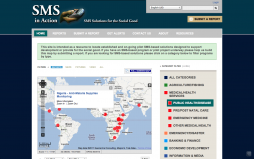
SMS in Action is an interactive crowdmap that allows users to submit and search for SMS-based systems that aim (or claim) to have a social impact. The map can be filtered by categories including Agriculture, Health, Emergency/Disaster Services, Banking, Economic Development, Information and Media, Education, and Governance with many of these categories dividing into further subcategories. Reports may also be filtered by report date.
Corresponding markers on the map can be clicked giving the user the option to zoom in/out or get more information. While clearly still in its early stages, the map has a lot to offer. A quick search for disease programs under medical/health returned over a dozen hits across the map. Additionally, users may subscribe to receive location-specific email alerts whenever a report is posted within 20 miles of a designated area.
ICT4D and M4D projects often focus on how mobiles can be used in developing countries, but the success and usefulness of these projects depends on the value mobile users place on their phones, and how they use them. "We Use It Different, Different: Making Sense of Trends in Mobile Use in Ghana," looks at how Ghanians use mobile phones in their day-to-day lives, mainly focusing on why survey participants started using a mobile phone, how they use it, and how they view the value of mobile phone ownership.
Aarogyam ICT for Mother and Child Care data sheet 222 Views
Author:
Tiwari, Alok
Publication Date:
Jul 2011
Publication Type:
Report/White paper
Abstract:
‘Aarogyam’ is a Sanskrit word which means "complete freedom from illness”. Aarogyam is an ICT based responsive system which ensures and involves active participation of all key stakeholders viz. local administration, health facilities and doctors, frontline health workers (ASHA (Accredited Social Health Activists), ANM (Auxiliary Nurse Midwife), and AWW (Angan Wadi Workers)), village heads and beneficiaries, to ensure that a pregnant woman is provided with ANC, PNC and complete immunization throughout the continuum of care. Aarogyam maintains a village wise database of all the beneficiaries (pregnant/lactating women, children up to 5 years) of an area, which gets continually updated with new data generating on the field with the help of front line health workers. The database thus generated is the backbone of the software system used by Aarogyam. This system generates automated alerts in the form of vernacular voice calls/SMS to the beneficiary thus enabling the beneficiary with vital information at their door step. The system not only provides beneficiary with the information to be acted upon but also ensures that the services are delivered to the beneficiary by generating automated alerts (vernacular voice calls/SMS) for the ANM and Block level health officials, informing them of due services in their area.
Bad Services? Holding Officials Accountable with SMS, Radio, and TRAC FM data sheet 2208 Views
A recent radio poll at Sanyu FM in Kampala, Uganda, asked listeners what area of service delivery should be a priority: healthcare, education, security, sanitation, or transport. Using a new tool, TRAC FM, the station was able to solicit comments via SMS from listeners, discuss the issue on the air, and create and post online visualizations of the responses. The station received 103 SMS responses which showed that healthcare was the major concern for listeners, which accounted for 65% of responses.
With help from Text to Change and in partnership with local media organizations, TRAC FM provides citizens in Uganda with a platform to monitor, scrutinize, and discuss public service issues via SMS, radio, and online data visualizations. It does this via the TRAC FM software, a tool for Ugandan radio stations that is partially built on RapidSMS, an open source platform originally developed by UNICEF.
TRAC works in countries affected by poverty and conflict. Its sole purpose is to improve the welfare of people by enabling them to make informed choices and to hold their leaders accountable. TRAC gathers data to enhance transparency and informs people by unleashing the power of mobile communications.
FrontlineSMS User Guide on Data Inegrity data sheet 94 Views
Author:
Lugo, Kristina and Carol Waters
Publication Date:
Aug 2011
Publication Type:
Report/White paper
Abstract:
FrontlineSMS is a software platform that enables structured communication via text messaging, using only a computer and a mobile phone or GSM (Global System for Mobile) modem. The platform enables two-way messaging between users and groups of people via mobile networks without the need for an Internet connection.
The purpose of this guide is to provide users with a framework to understand, analyze, and address the vulnerabilities, risks and threats that can affect the integrity of the information communicated through the FrontlineSMS platform. That said, mobile networks are inherently insecure and end users are only able to mitigate, as opposed to prevent, a significant number of the possible threats to data integrity. While there are a large number of ways that user information can be lost, altered, stolen, changed, or read by third parties, this guide focuses on the ways that users experience information corruption and steps that they can take to mitigate individual threats. This guide is intended to be a useful resource and framework, but is not intended to be comprehensive or prescriptive.
Users and potential users have different needs for protecting sensitive information. The goal of this guide is to outline the actions that can be taken to mitigate the risks posed by information being lost, changed or read by unauthorized third parties. However, it is important to recognize that FrontlineSMS may not be an appropriate tool to use in some environments where data integrity needs go beyond the capabilities of the platform and SMS itself, and that incautious use may put the organization, program and users at risk.
FrontlineSMS does not define the exact details of how users should deploy the software or address issues of data integrity. Users should evaluate their individual program goals, standards, and operating context to decide on the steps that should be taken to protect the integrity of their information
The mobile learning toolkit is the result of research into mobile phone use and user needs within the African context, however it has been developed for use in all developing contexts. It is intended as a “trainer’s toolkit” that can help deliver a wide range of training activities both inside and outside of the classroom.
The mobile learning toolkit is an open source resource that can be used in the delivery of all kinds of training in any context. It has been designed to be as inclusive as possible, with most of the methods requiring only low end devices (basic mobile phones with voice calling and SMS capability). In this way the toolkit can be used to deliver interactive learning experiences to participants right to the Base of the Pyramid (BoP).
Today's Mobile Minute brings you news about Apple's profit share, the Atlantic Magazine's case for texting, the launch of free SMS in Zimbabwe, a look at how mobile device users choose video apps, and a report on malware in Android's marketplace.
PC Mag reports that Apple's iOS, despite being only 20% of the world's smartphone market, receives roughly two-thirds of mobile phone profits. The magazine breaks down the data in several charts, showing operating profits across quarters, and how operating shares have changed between 2007 and now (in Q2 2007, Apple had 1% of the market and the most popular vendor, Nokia, had 55%; by Q2 2011, Apple has 66% of the market).
Curious about why SMS matters? Check out The Atlantic's "Why Texting is the Most Important Information Service in the World." The article pulls together a lot of statistics and real-world examples to demonstrate how SMS is used around the world. From government initiatives in the Philippines (the article reports "87 percent of Filipinos prefer communicating with the government via SMS, compared to 11 percent with an Internet-preference"), to mobile payments in Afghanistan, to agricultural info and help lines in Uganda, the piece looks at how SMS is changing the way people use their phones to interact with the world around them.
In other SMS news, the company Free SMS Zimbabwe has launched a new initiative that combines advertising with texting. Users of the service can send an SMS with a maximum of 100 characters and the other 60 will be an advertisement; users can send 100 character SMSs for free as the company subsidizes the cost through the ads.
When choosing mobile video apps, a Nielsen Wire survey reveals that the most important factor is "free/low subscription rates." Roughly 63% of respondents chose cost as a very important factor when choosing a mobile video application, more than other factors like video selection, presence of advertisements, or the ability to sync multiple devices.
The 2011 Mobile Threat Report, a new study from Lookout Mobile Security, found some big security threats to Android users. eWeek reports that "Android handset users are 2.5 times more likely to be affected by malware today than they were 6 months ago, as anywhere from 500,000 to 1 million users were impacted by malware on their smartphone or tablet computer."
[Mobile Minute Disclaimer: The Mobile Minute is a quick round-up of interesting stories that have come across our RSS and Twitter feeds to keep you informed of the rapid pace of innovation. Read them and enjoy them, but know that we have not deeply investigated these news items. For more in-depth information about the ever-growing field of mobile tech for social change, check out our blog posts, white papers and research, how-tos, and case studies.]
We spoke with Prairie Summer and Graham Gardner of Equal Access to learn more about that organization’s work integrating educational radio broadcasts with mobile-based tools such as SMS and IVR. As they explain, this combination has enabled them to better tailor their message to their their audience and has allowed for a unique form of interactive communication.
Equal Access creates communications strategies and outreach that address the most critical challenges affecting people in the developing world. Their work has focused on communications around issues such as women and girls' rights, democracy and governance, and education.
The Case of the Interdisciplinary Researcher: Using Mixed Methods to Observe ICT in Healthcare in Uganda data sheet 1364 Views
Author:
Densmore, Melissa R.
Publication Date:
Oct 2010
Publication Type:
Report/White paper
Abstract:
While researchers are often depicted as either ‘social scientists’ or ‘technologists’ often their educational and ideological backgrounds are much richer than the two simple terms might imply.
This paper describes the methodology and approach of a qualitative researcher with a computer science background in investigating how information technology changes communications and information management practices within the health ecosystem constitutued by a health subsidy program in southwest Uganda.
Huzzah for my Thing: Evaluating a Pilot of a Mobile Service in Kenya data sheet 2065 Views
Author:
Ledlie, Jonathan
Publication Date:
Jan 2010
Publication Type:
Report/White paper
Abstract:
Deploying and evaluating a new technology is a major challenge in ICTD research. Introducing new technologies can be hampered by a lack of cultural insight, poor or delayed feedback, and limited evaluation procedures, among other factors.
This short paper offers a model for introducing technology in developing regions that mitigates these factors. We call these steps the “Huzzah method,” inspired by a quotation that rightly derides technology that is introduced from afar and poorly evaluated.
The paper also includes selected portions from other work on Tangaza, whose design, implementation, and analysis followed the Huzzah method.